These notes were written by the person who submitted this item. Appraiser.AI has not verified them, and the AI's identification and estimate may rely on them.
AI Estimated Value
Not an official valuation
$25 - $40
AI estimate as of November 10, 2025 · verify with a professional before acting
AI-Generated · Verify before acting
Everything on this page is generated by AI for informational purposes only. AI can make mistakes — the AI may misidentify items or misattribute them (artist, maker, brand, designer, origin, era). This is not an official valuation and should not be used for insurance, sale, tax, estate, legal, or lending purposes — or any decision requiring a certified appraisal. It is not an authoritative claim about any person, brand, or rights holder — do not share or rely on it as a factual statement about a third party. Always consult qualified professionals before making financial decisions.
This analysis also relies on unverified notes provided by the user, which may be incomplete or inaccurate and could affect the result.
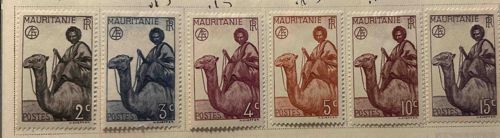
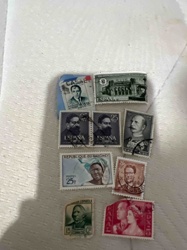
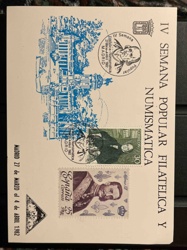
This item is a strip of six vintage postage stamps from Mauritania, featuring a consistent design of a person riding a dromedary camel. Each stamp is rectangular with perforated edges, indicative of standard postage stamp design. The dominant impression for each stamp is a central vignette of a rider, likely a Tuareg or similar North African figure, with dark skin and distinct facial features, adorned in traditional robes, seated atop a single-humped camel. The background for the rider and camel appears to depict a barren, sandy landscape, characteristic of a desert environment. Above the central image, the word "MAURITANIE" is prominently displayed, along with a stylized 'R' in a circle to the upper right corner, and possibly a symbol resembling an encircled 'A' or similar emblem to the upper left. The denomination of each stamp is located at the bottom right corner, with values of "2c", "3c", "4c", "5c", "10c", and "15c" visible. The word "POSTES" is printed along the bottom edge, indicating their function as postal stamps. Each stamp features a different primary color for the camel and rider, ranging from a grayish-black (2c), blue (3c), reddish-brown (4c), orange-brown (5c), dark brown (10c), to a reddish-purple (15c), creating a visually appealing gradient across the set. The perforations appear consistent across all stamps, suggesting they were part of a continuous sheet. The condition seems generally good, with clear printing and no apparent significant tears or creases, although minor signs of age or handling might be present upon closer inspection, such as slight toning or minor wear on the perforations. The stamps likely date from the period when Mauritania was under French colonial influence, given the French denomination 'c' for centimes and the term 'POSTES'. The craftsmanship appears to be of standard philatelic quality for its era, with intricate details in the engraving of the camel and rider.
AI Appraisal Report
I have examined the provided image of the Mauritania Postage Stamp Set featuring a rider on a camel. This appears to be a strip of six vintage stamps, depicting consistent design elements across various denominations (2c, 3c, 4c, 5c, 10c, 15c). The stamps show good visual clarity, with legible text and discernible details in the central vignette. The perforations seem intact and consistent, suggesting a generally good condition for philatelic items of this age, though minor toning or wear on perforations cannot be ruled out without physical inspection. The 'c' denomination and 'POSTES' indicate a probable French colonial era origin, common for Mauritanian issues. Authenticity, based solely on the image, appears strong as the design elements align with known Mauritanian issues of that period.
In terms of market conditions, these stamps are generally part of a common thematic collection (animals, colonial issues). While attractive, they are not considered rare. Demand is steady among collectors of French colonial issues or camel thematic stamps, but it's not exceptionally high. The value is primarily driven by their completeness as a strip, and their good visual condition.
Factors impacting value positively include the complete color range in a strip. The main limitation of this appraisal is the lack of physical examination. A hands-on inspection would be crucial to definitively assess the precise condition of gum (if present), the sharpness of the perforations, the absence of hidden faults (thinning, repairs), and precise print quality. Examining under magnification would confirm true authenticity and condition. Without this, I cannot rule out potential reprints or expertly regummed items, though the image does not suggest this.