AI identification & appraisal estimate

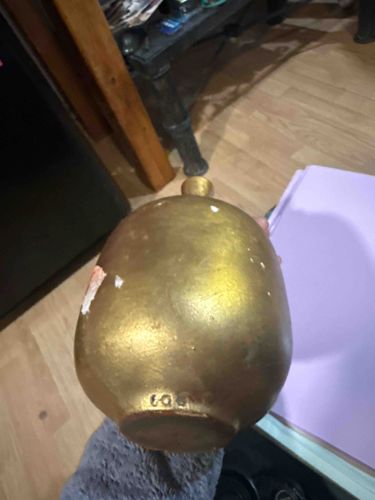
Gold-Painted Gourd Ornament or Decorative Item

Submitted photo of Gold-Painted Gourd Ornament or Decorative Item
Photo submitted by the user — not generated by AI

AI Estimated Value

Not an official valuation

$15-30

AI estimate as of October 3, 2025 · verify with a professional before acting

AI-Generated · Verify before acting

Everything on this page is generated by AI for informational purposes only. AI can make mistakes — the AI may misidentify items or misattribute them (artist, maker, brand, designer, origin, era). This is not an official valuation and should not be used for insurance, sale, tax, estate, legal, or lending purposes — or any decision requiring a certified appraisal. It is not an authoritative claim about any person, brand, or rights holder — do not share or rely on it as a factual statement about a third party. Always consult qualified professionals before making financial decisions.

Read the full disclaimer

AI Item Analysis

The item appears to be a decorative object, possibly a gourd or a gourd-shaped ornament, finished with a metallic gold paint. It has an ovoid or teardrop shape, wider at the bottom and tapering towards a narrower neck at the top. The surface is not perfectly smooth, suggesting a natural material like a dried gourd or a molded material designed to mimic one. The gold finish is somewhat uneven and shows signs of wear, particularly around the sides and edges, where patches of a lighter underlying material (possibly a whitish primer or natural gourd color) are visible. There are also several small, scattered white flecks, which could be paint loss or dust accumulation. At the bottom, there is a distinct impressed marking that reads "603", which likely indicates a model number, serial number, or a batch identification. The top features a small, round, knob-like protrusion, which could be the stem of a gourd, a finial, or an attachment point for a hanging mechanism, although no such mechanism is visible. The craftsmanship appears to be folk art or mass-produced decorative item quality, rather than fine art. The style suggests it could be from the mid-20th century onwards, aiming for a rustic yet opulent aesthetic. The item's primary function is likely decorative, perhaps as part of a seasonal display or general home decor. The overall condition suggests moderate wear consistent with age and handling.
AI Appraisal Report

I have examined the provided image of what appears to be a gold-painted gourd ornament or decorative item. Based on this visual examination, the item exhibits characteristics of a mass-produced decorative piece, likely from the mid-to-late 20th century. The ovoid, teardrop shape strongly suggests a dried gourd as the base material, although it could be a molded resin or plaster designed to mimic one. The gold finish shows significant wear, with patches of a lighter underlying material (possibly primer or the natural gourd color) visible, consonant with its age and use. The impressed '603' mark indicates a manufacturing identifier rather than a maker's signature, reinforcing its decorative production lineage. The small, round protrusion at the top appears to be a natural stem or a decorative finial. Authenticity is difficult to definitively confirm from images alone; however, the wear patterns seem consistent with age rather than intentional distressing. An in-person examination would be crucial to determine the exact material (natural gourd vs. synthetic), the quality of the gold application, and to assess the stability of the finish and any repairs. Without provenance, attributing it to a specific maker or period beyond general categorizations is challenging. Market conditions for such decorative items are generally modest. Comparables often include similar vintage gold-tone decorative objects or painted natural elements, which typically sell in the range of $10 to $40, depending on size, condition, and desirability of the aesthetic. This item is not rare, and demand is limited to niche collectors of vintage home decor or those seeking specific accent pieces. Factors impacting value are primarily condition and aesthetic appeal. The uneven wear and somewhat common design limit its value. A full appraisal would necessitate physical inspection to verify material composition, assess structural integrity, and determine if any restoration has occurred.

Keep exploring

More decorative object appraisals

Get your items appraised

Instant AI-powered appraisal estimates from a photo

Browse More Appraisals