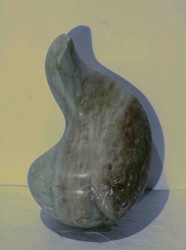
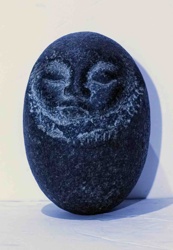
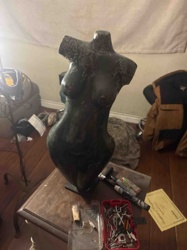
These notes were written by the person who submitted this item. Appraiser.AI has not verified them, and the AI's identification and estimate may rely on them.
AI Estimated Value
Not an official valuation
$4,000-6,000
AI estimate as of December 11, 2025 · verify with a professional before acting
AI-Generated · Verify before acting
Everything on this page is generated by AI for informational purposes only. AI can make mistakes — the AI may misidentify items or misattribute them (artist, maker, brand, designer, origin, era). This is not an official valuation and should not be used for insurance, sale, tax, estate, legal, or lending purposes — or any decision requiring a certified appraisal. It is not an authoritative claim about any person, brand, or rights holder — do not share or rely on it as a factual statement about a third party. Always consult qualified professionals before making financial decisions.
This analysis also relies on unverified notes provided by the user, which may be incomplete or inaccurate and could affect the result.
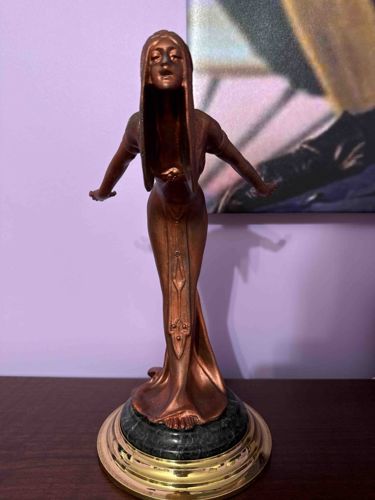
This item is an Art Nouveau bronze statue depicting a female figure, likely designed by Gustav Gurschner. The figure stands elegantly, with arms slightly outstretched and an expressive, open-mouthed face, suggesting a lyrical or dramatic pose. Her hair is long and flows down both sides, framing her face and draping over her shoulders and back. She wears a long, flowing gown that clings to her form, elaborately decorated with a stylized, elongated motif resembling a fleur-de-lis or a similar organic Art Nouveau design running vertically down the front of the skirt. Her bare feet are visible at the base of the statue, resting on the pedestal. The statue exhibits a rich, reddish-brown patinated bronze finish, characteristic of the period and material. The figure is mounted on a multi-tiered circular base: an inner disc of dark green marble with white veining, set into a larger, polished brass or bronze ring. The overall condition appears good, with a consistent patina, indicating a well-preserved piece. No significant visible damage, chips, or repairs are immediately apparent from the provided images, though closer inspection would be needed to confirm. The craftsmanship is fine, typical of Art Nouveau bronzes, with detailed facial features and graceful drapery of the clothing. While no specific maker's marks are visible in these images, the style strongly aligns with works by Gustav Gurschner, estimated to be from the late 19th to early 20th century.
AI Appraisal Report
Upon examining the provided image of this Art Nouveau bronze female figure, I can state with reasonable confidence that it presents as a fine example of the period, strongly attributable to Gustav Gurschner. The graceful pose, the expressive face, the flowing hair, and the stylized, organic ornamentation on the gown are all hallmarks of Gurschner's distinctive Art Nouveau aesthetic. The reddish-brown patinated bronze finish appears consistent and well-preserved, suggesting good overall condition. No significant damage, such as dents, scratches, or repairs, is immediately apparent, which positively impacts its value.
The multi-tiered base, featuring dark green marble set into a brass or bronze ring, is period-appropriate and complements the sculpture. Authenticity, while strongly indicated by style, cannot be definitively confirmed without physical inspection. I would need to examine any potential foundry marks, artist signatures, or inventory numbers, which are not visible in the provided images. Provenance documentation, such as original purchase receipts or exhibition records, would also significantly aid in full authentication.
Market conditions for quality Art Nouveau bronzes by recognized artists like Gurschner remain stable, with consistent demand among private collectors and institutions. Comparables from recent auction results for Gurschner's figural bronzes of similar size and complexity typically fall within the $3,500 to $7,000 range, depending heavily on condition, provenance, and exact model rarity. This piece appears to be in a desirable condition and represents a classic Gurschner motif. The artistic merit and condition are the primary value drivers, assuming authenticity is corroborated through further examination.