AI Appraisal Estimate

AI-generated estimates · not official valuations

From the user

What was submitted

Photo and notes provided by the user — not generated by AI

Submitted item photo
Submitted photo · June 10, 2026

User's notes

No additional notes provided.

AI analysis below

AI appraisal

AI analysis & estimate

AI-Generated · Verify before acting

Everything below is generated by AI for informational purposes only. AI can make mistakes — the AI may misidentify items or misattribute them (artist, maker, brand, designer, origin, era). This is not an official valuation and should not be used for insurance, sale, tax, estate, legal, or lending purposes — or any decision requiring a certified appraisal. It is not an authoritative claim about any person, brand, or rights holder — do not share or rely on it as a factual statement about a third party. Always consult qualified professionals before making financial decisions.

Read the full disclaimer

AI Identification

·Not independently authenticated·Verify before acting

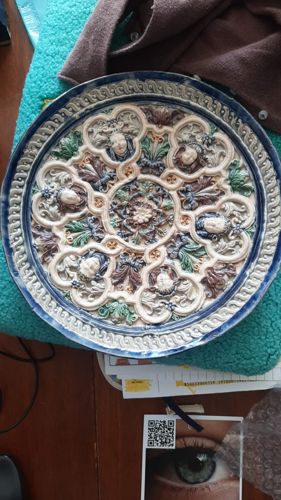
Majolica Relief Charger with Putti and Scrolling Foliage

Decorative Ceramics / Art Pottery

AI Estimated Value

·Not an official valuation·Verify before acting

$450 - $700

As of June 10, 2026

AI Item Analysis

·AI can make mistakes·Verify before acting
This is a heavy, circular ceramic charger or wall plaque rendered in high-relief majolica-style earthenware. The piece features a complex, symmetrical composition dominated by a central floral rosette, from which radiating scrollwork and interlocking cream-colored ribbons emanate. Set within six distinct cartouches are three-dimensional cherubic faces (putti) with varied expressions, interspersed with motifs of mythical griffins and acanthus-style leaves. The color palette is characteristic of Renaissance-era revivals, utilizing a deep cobalt blue border, rich ochre/browns, emerald greens, and a cream-white glaze for the high-relief elements. The border is finished with a gadrooned or rope-twist pattern in white against the blue rim. Construction indicates a molded core with hand-applied glazes. Condition-wise, the piece appears to be in fair condition with visible crazing throughout the glaze, which is a common aging characteristic for majolica. There are minor abrasions on the high points of the relief and some slight pigment loss, though no major structural cracks are visible from the front. The style suggests a late 19th-century Neo-Renaissance or 20th-century Italian Palissy revival influence. The complex depth of the relief work indicates a high level of craftsmanship and technical modeling.
AI Appraisal Report

·AI can make mistakes·Verify before acting
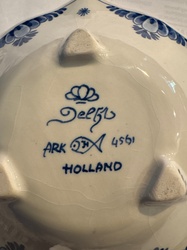
I have conducted a visual inspection of this Majolica Relief Charger featuring a neoclassical 'putti and scroll' motif. Based on the complex modeling and saturated color palette, the piece likely originates from a late 19th-century European workshop, possibly Italian (Deruta or Castelli tradition) or French, operating in the Neo-Renaissance revival style. The high-relief execution shows significant technical skill, particularly in the depth of the central rosette and the anatomical detail of the six putti. The presence of 'crazing' (fine cracking in the glaze) and some pigment loss on high points is consistent with age and the specific thermal expansion properties of majolica earthenware. While these factors diminish the piece's 'mint' status, they reinforce its period authenticity. The market for 19th-century Majolica remains stable but selective; there is high demand for complex relief work like this, though the lack of a visible maker's mark (such as Minton or Ginori) keeps the value within a mid-range decorative bracket. Comparables for unsigned 15-18 inch relief chargers typically realize between $400 and $800 at specialized auction. It is important to note that this appraisal is based on image analysis alone. A physical inspection is required to definitively rule out professional restorations to the delicate relief elements, which are common and can significantly decrease value. Furthermore, a physical examination of the 'foot' and any impressed marks on the reverse would be necessary to identify the specific manufacturer and establish a more precise provenance.

Get your items appraised

Instant estimates of your treasures with AI-powered appraisals

Browse More Appraisals