AI estimate as of October 17, 2025 · verify with a professional before acting
AI-Generated · Verify before acting
Everything on this page is generated by AI for informational purposes only. AI can make mistakes — the AI may misidentify items or misattribute them (artist, maker, brand, designer, origin, era). This is not an official valuation and should not be used for insurance, sale, tax, estate, legal, or lending purposes — or any decision requiring a certified appraisal. It is not an authoritative claim about any person, brand, or rights holder — do not share or rely on it as a factual statement about a third party. Always consult qualified professionals before making financial decisions.
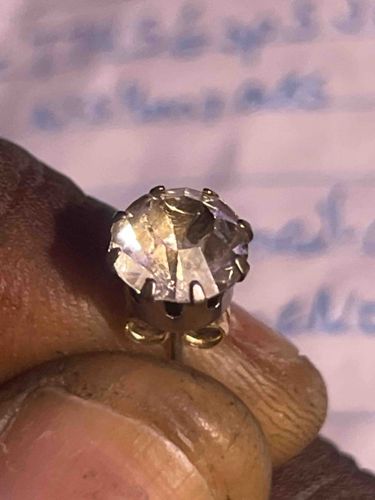
This item is a single stud featuring a large, clear, round faceted rhinestone prominently set in a pronged metal mounting. The rhinestone exhibits multiple facets, providing a brilliant appearance with noticeable internal reflections and refractions of light. Its color appears to be colorless or very near-colorless, mimicking a diamond. The setting consists of multiple silver-toned metal prongs, likely six or eight, meticulously holding the rhinestone in place around its girdle. The base of the setting, beneath the stone, reveals a golden-toned metal component, possibly indicating a mixed metal construction or a plated finish. A thin, straight post extends from the back of the setting, typical for an earring stud or a component that would be affixed to another piece. The overall construction suggests a mass-produced jewelry item. Visual inspection indicates a good general condition for the rhinestone, with no obvious chips, cracks, or significant abrasions visible to the naked eye, though detailed magnification would be required to confirm its pristine state. The metal setting shows some slight discoloration or patina consistent with age and handling, particularly on the silver-toned prongs, and a clear view of the golden-toned base. The piece appears to be a costume jewelry component, likely from the mid-to-late 20th century, given the style of setting and typical materials used for such items. There are no visible maker's marks or distinguishing hallmarks in the provided image. The craftsmanship, while functional, is characteristic of standard commercial jewelry production rather than high-end artisan work.
AI Appraisal Report
I have visually examined the provided image of a single clear rhinestone stud. The item features a large, round faceted clear rhinestone securely set in a multi-pronged, silver-toned metal mounting. The rhinestone appears brilliant with good internal reflections, consistent with quality costume jewelry rhinestones. Its condition seems good, with no obvious chips or cracks visible, though a physical inspection under magnification would be crucial to confirm this. The setting shows some minor discoloration or patina, which is expected for an item of its presumed age and material. A golden-toned metal component is visible on the base, suggesting a mixed metal construction or plating. A thin post extends from the back, typical for an earring or a component.
Authenticity: Based on visual cues, this is clearly a piece of costume jewelry. There are no hallmarks or maker's marks visible, which is common for mass-produced items of this type. The overall craftsmanship points to standard commercial production rather than fine jewelry or artisan work. Without physical examination, I cannot definitively ascertain the exact material composition of the metals or the rhinestone (e.g., glass vs. crystal).
Market Conditions and Demand: Items like this single stud have limited market demand unless they are part of a complete, matching set, or if the rhinestone has a collectible provenance (e.g., Swarovski, specific historical context). As a single, unmarked component, its demand is very low. Similar mass-produced costume jewelry studs from the mid-to-late 20th century are widely available.
Factors impacting value: The primary factors limiting its value are its status as a single, generic costume jewelry component, lack of identifiable maker, and common materials. Its good condition provides minimal uplift.
Limitations: A full authentication would require in-person examination to inspect for micro-inscriptions, assess the metal composition (e.g., base metal vs. sterling plated), determine the exact material of the stone (glass, crystal, acrylic), and check for any hidden damage or repairs. Provenance documentation would be necessary to attribute it to a specific manufacturer or collection, which would significantly impact value. Without these, the appraisal is solely based on visual characteristics and market comparables for generic costume components.