AI estimate as of September 28, 2025 · verify with a professional before acting
AI-Generated · Verify before acting
Everything on this page is generated by AI for informational purposes only. AI can make mistakes — the AI may misidentify items or misattribute them (artist, maker, brand, designer, origin, era). This is not an official valuation and should not be used for insurance, sale, tax, estate, legal, or lending purposes — or any decision requiring a certified appraisal. It is not an authoritative claim about any person, brand, or rights holder — do not share or rely on it as a factual statement about a third party. Always consult qualified professionals before making financial decisions.
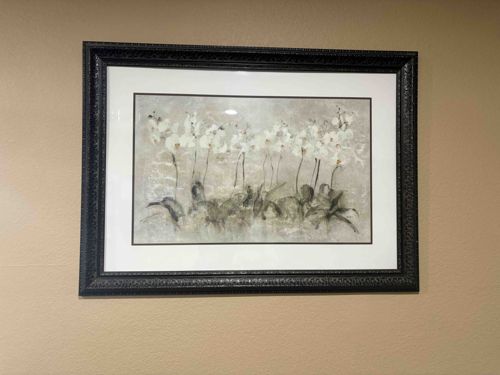
This item is a framed print depicting a series of white Phalaenopsis orchids with light green foliage and stems, set against a muted, somewhat textured grey-brown background. The artwork appears to be a modern piece, likely a reproduction print rather than an original painting, characterized by a soft, almost watercolor-like aesthetic or possibly a giclée print. The orchids are arranged horizontally across the frame, showcasing their delicate white petals and contrasting dark centers. The foliage below the blossoms is rendered in shades of green and grey, contributing to the overall subdued palette. The print is matted with a generous white border, which creates a significant visual separation between the artwork and the frame, enhancing its presentation. A thinner, dark inner border (possibly black or very dark grey) directly abuts the print itself, providing a crisp edge. The frame is a rectangular, ornate dark-colored (likely black or dark brown) wood or composite material, featuring an intricate, possibly carved or molded, decorative pattern along its inner and outer edges. The surface of the frame has a somewhat textured or distressed finish, adding depth to its appearance. The item is displayed hanging on a neutral-toned, textured wall, suggesting it is a decorative piece for an interior space. No significant condition issues like scratches, dents, or discolored areas are visible on the frame or the print from the given image, and the glass appears clean. The overall style is contemporary, leaning towards a sophisticated botanical theme suitable for various décor styles, from traditional to transitional. The quality of the printing and framing appears to be good, indicating a commercially produced item.
AI Appraisal Report
I have examined the provided image of the framed print depicting white Phalaenopsis orchids. My assessment is based solely on visual inspection of the image provided. The print appears to be a modern reproduction, likely a giclée or similar high-quality print, given its soft aesthetic and fine detail. It is matted with a clean white border and a thin dark inner border, presented within an ornate dark-colored frame with a textured finish.
From the image, the condition appears excellent; I observe no visible damage such as scratches, dents, or discoloration to the print or frame, and the glass (if present) appears clean. Authenticity as an original artwork cannot be determined from an image; this is clearly a reproduction. This piece is a commercially produced decorative item.
Market conditions for framed art prints of this nature are generally steady. Comparable pieces, often found in home decor stores or online retailers, typically range from $60 to $200, depending on size, framing quality, and artist (if known, though this appears to be an uncredited botanical print). There is no inherent rarity for commercially produced prints of this style. Demand is moderate, driven by interior decorating trends. Factors impacting value include the quality of the print medium, the framing materials, and its overall aesthetic appeal which is good here. Without physical inspection, I cannot confirm the exact printing method (e.g., giclée vs. offset lithograph), the material of the frame (wood vs. composite), or the presence and type of glazing. In-person examination would allow for definitive assessment of print quality, frame materials, and overall physical condition, which could slightly refine the value within the given range.