These notes were written by the person who submitted this item. Appraiser.AI has not verified them, and the AI's identification and estimate may rely on them.
AI Estimated Value
Not an official valuation
$40-70
AI estimate as of September 23, 2025 · verify with a professional before acting
AI-Generated · Verify before acting
Everything on this page is generated by AI for informational purposes only. AI can make mistakes — the AI may misidentify items or misattribute them (artist, maker, brand, designer, origin, era). This is not an official valuation and should not be used for insurance, sale, tax, estate, legal, or lending purposes — or any decision requiring a certified appraisal. It is not an authoritative claim about any person, brand, or rights holder — do not share or rely on it as a factual statement about a third party. Always consult qualified professionals before making financial decisions.
This analysis also relies on unverified notes provided by the user, which may be incomplete or inaccurate and could affect the result.
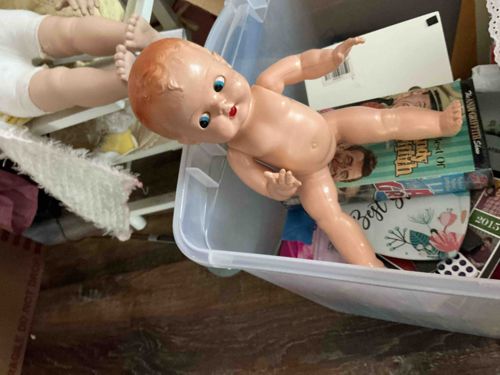
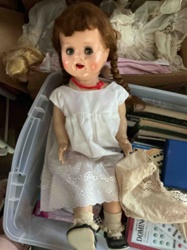
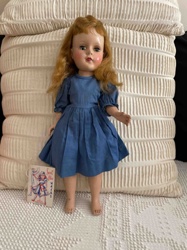
This item is identified as a vintage baby doll, likely manufactured by Ideal, based on the provided context. The doll features a light, peach-toned plastic or hard rubber body, indicative of materials used in mid-20th-century doll production. Physical characteristics include a molded head with sculpted red-orange hair, creating a textured, curled appearance. The doll has painted facial features: large blue sleep eyes with defined black pupils, and a small, red, somewhat puckered mouth. There are no visible eyelashes or eyebrows. The body is a single-piece mold for the torso and limbs, suggesting a simpler, less articulated construction typical of baby dolls from earlier eras. The limbs are jointed at the shoulders and hips, allowing for basic posing, with the arms and legs appearing somewhat thicker and stubbier, characteristic of a baby's proportions. The doll lacks clothing, revealing a smooth, unblemished surface across most of its visible body. There are no obvious cracks, chips, or significant scuffs, though general surface dirt or light discoloration consistent with age might be present. No maker's marks or signatures are discernible from the image. The style and construction suggest an estimated age from the 1940s to 1960s. The quality indicates a mass-produced item, though the molding appears relatively crisp, without significant seams, suggesting decent craftsmanship for its type. One unique aspect is its classic, somewhat exaggerated 'baby look' with round features and large eyes, often associated with this period of doll manufacturing.
AI Appraisal Report
Based on my visual examination of the provided image, this vintage baby doll exhibits characteristics consistent with an Ideal brand doll, likely from the 1940s-1960s. The light, peach-toned plastic/hard rubber body, molded red-orange hair, and painted blue sleep eyes align with typical Ideal doll features of that era. The lack of visible significant defects like chips, cracks, or heavy scuffing suggests good to very good condition for a doll of this age, though minor surface dirt or discoloration is anticipated without a physical inspection. The jointed limbs indicate basic articulation, which is common.
Authenticity relies heavily on the 'Ideal' identification provided by the owner, as no discernible maker's marks are visible in the image. Without a clear mark, definitive identification as an Ideal doll solely from the image is challenging, given that many manufacturers produced similar 'baby look' dolls during this period.
Market conditions for unboxed, unnamed vintage plastic baby dolls, even from Ideal, are generally moderate unless they are a particularly rare model or in pristine, MIB condition. Comparables for similar Ideal dolls in good, played-with condition typically range. Demand is stable but not exceptionally high for these common types. Factors impacting value include the lack of original clothing, box, or specific identifying marks. If this were a known, sought-after Ideal model, the value could increase.
To fully authenticate and provide a more precise valuation, an in-person examination is crucial. This would allow me to inspect for maker's marks, assess the exact material composition, verify joint integrity, and thoroughly evaluate the surface condition (e.g., hazing, stickiness, hidden repairs). Provenance documentation from the owner would also be invaluable in confirming its history and manufacturer. Without these, my appraisal is based on visual cues and the assumption of the 'Ideal' attribution.