AI estimate as of July 12, 2025 · verify with a professional before acting
AI-Generated · Verify before acting
Everything on this page is generated by AI for informational purposes only. AI can make mistakes — the AI may misidentify items or misattribute them (artist, maker, brand, designer, origin, era). This is not an official valuation and should not be used for insurance, sale, tax, estate, legal, or lending purposes — or any decision requiring a certified appraisal. It is not an authoritative claim about any person, brand, or rights holder — do not share or rely on it as a factual statement about a third party. Always consult qualified professionals before making financial decisions.
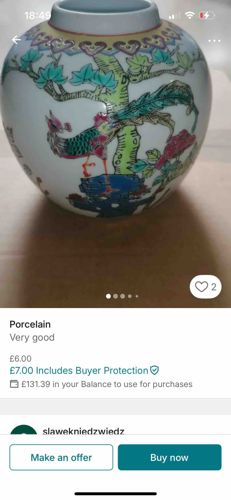
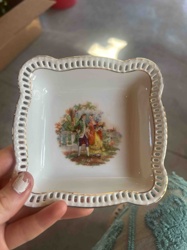
This appears to be a small, globular porcelain vase or ginger jar, characterized by its rounded body and a short, narrowed neck at the top opening. The primary color of the porcelain is white, serving as a bright canvas for the vibrant polychrome enamel decorations. The design features a scene with what appears to be a stylized bird, possibly a phoenix or rooster, with vivid green and fuchsia plumage, standing amidst lush, green foliage and tree trunks. The leaves are depicted in various shades of green, with some reddish accents on other floral or rock elements. A dark blue, almost black, element is visible at the base of the bird, possibly representing rockwork or water.
Enhancing the overall aesthetic, there is a decorative border around the top rim of the vase, featuring intricate patterns in yellow and possibly a darker contrasting color, suggesting a delicate repeating motif. The craftsmanship appears to be hand-painted, evident from the varying line weights and color saturation, adding to its artisanal appeal. There are no immediately obvious chips or cracks visible from this angle, suggesting a 'Very good' condition as described in the accompanying text. The surface exhibits a subtle sheen typical of glazed porcelain. Given the style of decoration, it likely originates from an East Asian tradition, possibly Chinese, and could be a modern decorative piece or a more aged antique, though without clearer markings or a view of the base, precise dating is difficult. The vibrant colors and detailed motifs indicate a certain level of quality in its production. It appears to be relatively small, suitable for a shelf or tabletop display.
AI Appraisal Report
Upon visual examination of the provided image, this polychrome porcelain jar presents as a well-preserved decorative piece. The condition appears to be 'Very Good,' with no visible chips, cracks, or significant wear. The vibrant, hand-painted polychrome enamel decoration, featuring avian and floral motifs, suggests an East Asian origin, likely Chinese, given the stylistic elements. The craftsmanship appears to be of good quality, with attention to detail in the brushwork and color application.
However, a definitive appraisal is limited without in-person examination. Authenticity, particularly regarding age, cannot be fully verified from images alone. While the 'Very Good' condition is noted, tactile inspection is necessary to confirm the integrity of the glaze, detect hairline fractures, or professional repairs that are not visible. For full authentication and accurate dating, I would require a physical inspection to examine the base for reign marks or artist signatures, assess the body composition for characteristics of specific historical periods (e.g., porcelain type, firing imperfections), and potentially conduct scientific testing such as thermoluminescence dating if an antique attribution is suspected.
Market conditions for such pieces are generally influenced by age, provenance, artist attribution (if any), and overall condition. Without these crucial details, this piece falls into a broad category of decorative porcelain. Demand for well-executed decorative porcelain remains stable, though rarity is difficult to ascertain without more information. Assuming it is a modern decorative piece, its value is primarily driven by its aesthetic appeal and condition. If it were to be authenticated as an antique with significant age or notable provenance, the value would increase substantially.
Based solely on its visual appeal as a decorative item in very good condition, and without any historical or artist attribution, my appraisal reflects its current market as an attractive, well-made decorative object.