These notes were written by the person who submitted this item. Appraiser.AI has not verified them, and the AI's identification and estimate may rely on them.
AI Estimated Value
Not an official valuation
$25 - $75
AI estimate as of December 12, 2025 · verify with a professional before acting
AI-Generated · Verify before acting
Everything on this page is generated by AI for informational purposes only. AI can make mistakes — the AI may misidentify items or misattribute them (artist, maker, brand, designer, origin, era). This is not an official valuation and should not be used for insurance, sale, tax, estate, legal, or lending purposes — or any decision requiring a certified appraisal. It is not an authoritative claim about any person, brand, or rights holder — do not share or rely on it as a factual statement about a third party. Always consult qualified professionals before making financial decisions.
This analysis also relies on unverified notes provided by the user, which may be incomplete or inaccurate and could affect the result.
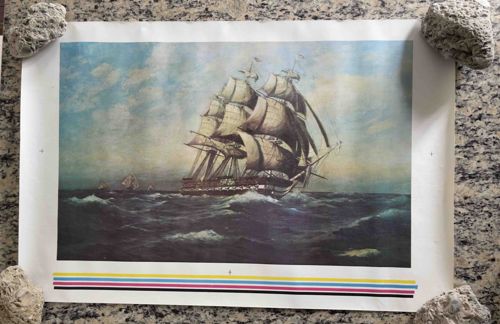
This item is a printer's proof of a sailboat seascape art print, depicting a large, multi-masted sailing ship with full sails navigating choppy, dark blue-green waters under a dramatic sky with light blue and grey cloud formations. The print is rendered in a realistic, classical style, suggesting a historical maritime subject. The primary vessel is prominently featured in the middle to right side of the composition, with smaller ancillary vessels visible in the distance on the left. The waves are depicted with white highlights, indicating foam and movement. The print is on a white, matte paper stock, likely an uncoated or semi-coated paper for proofing purposes, given its slightly textured appearance. The most defining feature identifying it as a printer's proof are the CMYK (Cyan, Magenta, Yellow, Black) color bars, along with a registration mark, positioned at the bottom edge of the white border. These bars are essential for printers to ensure accurate color reproduction and registration during the printing process. The print exhibits some minor handling wear, particularly visible along the edges where the paper might be slightly creased or dog-eared, but the central image appears to be in good condition. The overall color saturation and detail are high, indicating a quality printing process. The visible 'bleed' around the image area suggests it would be trimmed down for final production. The style of the artwork points to a possible 19th or early 20th-century artistic influence, though the print itself is a modern reproduction. The rocks placed at the corners are for holding the proof flat for photography, and not part of the item itself.
AI Appraisal Report
I have examined the provided image of this 'Sailboat Seascape Art Print (Printer's Proof)'. Based on visual inspection, the item is a modern reproduction, specifically a printer's proof, indicated by the CMYK color bars and registration mark at the bottom edge. While the central image depicts a multi-masted sailing ship in a classical style, reminiscent of 19th or early 20th-century maritime art, this is a print, not an original work of art. The condition appears good for a proof, with minor handling wear evident along the edges, consistent with its function in the printing process. The central image itself retains high detail and color saturation.
Market conditions for printer's proofs of modern art reproductions are generally modest. These items are intrinsically secondary to the final printed edition and typically have limited collectible appeal unless associated with a highly renowned artist or significant publication. Comparables include other art print proofs or pre-production samples, which rarely command high prices. Demand for such specific proofs, especially for a decorative seascape, is niche, primarily appealing to individuals interested in printmaking processes or those who simply enjoy the image itself. Its rarity, in the sense of being a proof, doesn’t translate to high value given the subject and lack of a prominent artist.
Factors significantly impacting value include the fact that it is a proof, not a finished art print, and lacks a definitive artist attribution or edition number. The absence of an original signature or unique artist input means it is valued more as a production curio than fine art. Without further information, it's impossible to verify the artist or the exact printing venture. For full authentication and to potentially identify the source artist, an in-person examination would be required to look for blind stamps, watermarks, or any subtle textual information. Provenance documentation, such as records from the printer or publisher, would be critical to ascertain its origin and the artist it represents. However, given its nature as a printing proof for what appears to be a decorative print, significant value is unlikely.