Vintage Industrial Single-Sheave Cast Iron Pulley with Hook
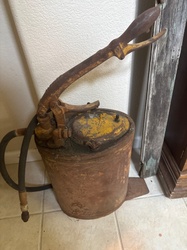
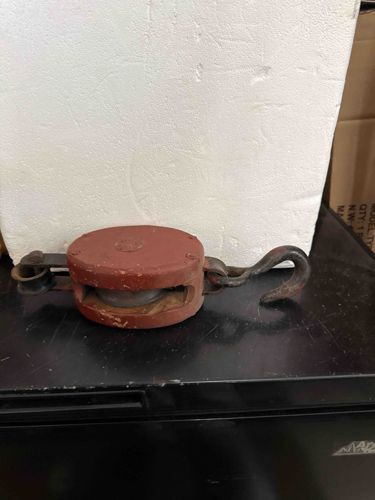
This is a vintage industrial single-sheave pulley block, constructed primarily of heavy-duty cast iron and forged steel components. The central housing or 'frame' features a circular, drum-like shape finished in a distressed dark red or oxide-toned paint. Contained within this housing is a rotating metal wheel (sheave) designed to guide a rope or cable. Attached to one end via a hinged swivel joint is a large, weathered steel forged hook, showing a dark, naturally oxidized patina. The opposite end features a smaller secondary guide roller assembly. Physically, the item exhibits significant signs of age and utilitarian use, including scattered paint chips, surface rust, and minor abrasions throughout the red finish. There appears to be a faint circular mark or embossing on the top center of the housing, which likely originally identified the manufacturer or weight capacity, though it is currently obscured by wear. The construction suggests an early to mid-20th-century tool designed for agricultural, marine, or construction hoisting. The craftsmanship is robust and functional rather than decorative, indicating it was built for durability under high-load conditions.
AI-Generated Appraisal Disclaimer
Estimated Value
$45 - $85
Basic Information
Category
Industrial Antiques and Tools
Appraised On
January 9, 2026
Estimated Value
$45 - $85
Item Description
This is a vintage industrial single-sheave pulley block, constructed primarily of heavy-duty cast iron and forged steel components. The central housing or 'frame' features a circular, drum-like shape finished in a distressed dark red or oxide-toned paint. Contained within this housing is a rotating metal wheel (sheave) designed to guide a rope or cable. Attached to one end via a hinged swivel joint is a large, weathered steel forged hook, showing a dark, naturally oxidized patina. The opposite end features a smaller secondary guide roller assembly. Physically, the item exhibits significant signs of age and utilitarian use, including scattered paint chips, surface rust, and minor abrasions throughout the red finish. There appears to be a faint circular mark or embossing on the top center of the housing, which likely originally identified the manufacturer or weight capacity, though it is currently obscured by wear. The construction suggests an early to mid-20th-century tool designed for agricultural, marine, or construction hoisting. The craftsmanship is robust and functional rather than decorative, indicating it was built for durability under high-load conditions.

Get Your Items Appraised
Instant estimates of your treasures with AI-powered instant appraisals