AI Appraisal Estimate

AI-generated estimates · not official valuations

From the user

What was submitted

Photo and notes provided by the user — not generated by AI

Submitted item photo
Submitted photo · June 13, 2026

User's notes

No additional notes provided.

AI analysis below

AI appraisal

AI analysis & estimate

AI-Generated · Verify before acting

Everything below is generated by AI for informational purposes only. AI can make mistakes — the AI may misidentify items or misattribute them (artist, maker, brand, designer, origin, era). This is not an official valuation and should not be used for insurance, sale, tax, estate, legal, or lending purposes — or any decision requiring a certified appraisal. It is not an authoritative claim about any person, brand, or rights holder — do not share or rely on it as a factual statement about a third party. Always consult qualified professionals before making financial decisions.

Read the full disclaimer

AI Identification

·Not independently authenticated·Verify before acting

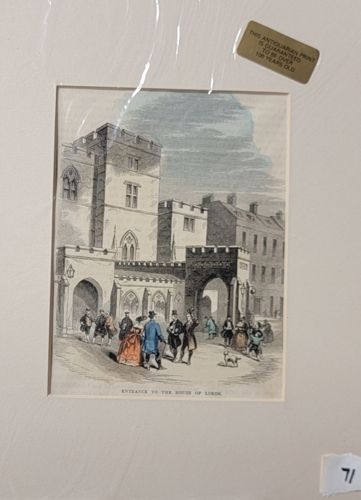
Entrance to the House of Lords - 19th Century Antiquarian Steel Engraving

Antique Art & Prints

AI Estimated Value

·Not an official valuation·Verify before acting

$45-75

As of June 13, 2026

AI Item Analysis

·AI can make mistakes·Verify before acting
This is an original 19th-century antiquarian print titled 'Entrance to the House of Lords.' The piece is a hand-colored steel engraving, typical of the mid-to-late 1800s, depicting a bustling scene outside the Gothic Revival architecture of the British Parliament. The print features a composition of figures in Victorian-era attire, including gentlemen in top hats and frocks, a woman in a voluminous orange-red skirt, and various townspeople, including a small dog in the foreground. The architectural elements are rendered with fine detail, showcasing crenelated towers, lancet windows, and arched gateways in shades of cream and stone grey against a soft blue and grey sky. The item is currently housed in a modern off-white paper mount (matting) and appears to be wrapped in protective clear plastic. A gold-toned sticker on the mount states: 'THIS ANTIQUARIAN PRINT IS GUARANTEED TO BE OVER 100 YEARS OLD.' Despite this guarantee, the print itself shows characteristic signs of age, including subtle tonal shifts in the paper and minor foxing or oxidation that contributes to an authentic antique patina. The hand-coloring remains relatively vibrant, suggesting it has been kept out of direct UV light. There is a small handwritten number '71' on a corner tag, likely a gallery or auction lot identifier. The craftsmanship is high, indicative of the skilled line work required for steel engraving plates during the Victorian era. The title is clearly printed at the base of the image within the plate mark area.
AI Appraisal Report

·AI can make mistakes·Verify before acting
I have examined the provided image of the 19th-century steel engraving titled 'Entrance to the House of Lords.' The work exhibits the characteristic fine-line detail of mid-to-late Victorian printmaking. The presence of incidental foxing and tonal shifts in the paper support the 'over 100 years old' guarantee. The hand-coloring, particularly the warm reds in the costuming, appears well-preserved, suggesting limited exposure to UV light. The modern matting provides a clean presentation, though the acidic nature of the original paper remains a factor for long-term conservation. Market demand for architectural steel engravings of London landmarks is currently stable but modest. These were produced in significant quantities for Victorian-era travelogues and periodicals, meaning they are not considered 'rare' in the fine art market. Comparable sales for individually matted, hand-colored Parliament-related engravings typically fall in the $40 to $80 range, depending on the renown of the original engraver or illustrator (such as Allom or Shepherd). Limitations to this appraisal include the inability to inspect the back of the paper (versos) for watermarks or historical inscriptions due to the matting. I cannot confirm the specific volume/source of origin or verify if the hand-coloring is period-correct or a later 20th-century addition—a common practice to enhance marketability. To fully authenticate the piece, I would require an out-of-frame inspection to check for a plate mark impression, paper weight, and a fiber analysis to distinguish between wood pulp and rag paper. Provenance documentation from a reputable gallery would further solidify its historical context.

Get your items appraised

Instant estimates of your treasures with AI-powered appraisals

Browse More Appraisals