AI estimate as of August 17, 2025 · verify with a professional before acting
AI-Generated · Verify before acting
Everything on this page is generated by AI for informational purposes only. AI can make mistakes — the AI may misidentify items or misattribute them (artist, maker, brand, designer, origin, era). This is not an official valuation and should not be used for insurance, sale, tax, estate, legal, or lending purposes — or any decision requiring a certified appraisal. It is not an authoritative claim about any person, brand, or rights holder — do not share or rely on it as a factual statement about a third party. Always consult qualified professionals before making financial decisions.
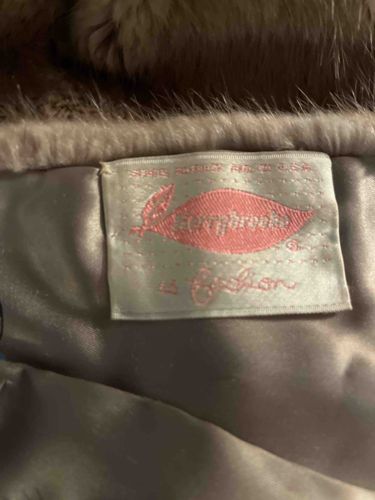
The item depicted is a cream or very pale beige fabric tag, presumably sewn into an article of clothing or accessory, most likely a fur coat or trim, given the visible fur-like texture immediately above the tag. The tag itself is rectangular, with neatly stitched edges. The primary color of the tag is a light, almost iridescent, cream or champagne hue, suggesting a silk or satin material, indicative of a luxury or high-quality garment. The text and graphical elements on the tag are embroidered or printed in a contrasting matte pink or light red color. \n\nThe most prominent feature is a stylized, elongated, leaf-like or possibly lip-like graphic which contains the word "Cleopatra" in a flowing, cursive script. Below this main graphic and text, there appears to be another line of script, possibly a signature or another brand name, which is partially obscured but seems to read "Casan" or a similar word with a prominent 'C' and an 'n' at the end. Above the main graphic, the tag also features smaller, fine-print text, which is largely illegible but appears to be care instructions, further details about the material, or a slogan, beginning with the words "Since 19XX" or "Style Number". \n\nThe visible condition of the tag suggests minimal wear; the fabric is smooth with no visible fraying or discoloration beyond what might be subtle shadows from the folds of the surrounding garment. There are no obvious tears, loose threads, or significant fading of the color in the embroidered/printed design. The stitching holding the tag in place appears intact and secure. The elegance of the script and the material choice for the tag itself point to a vintage item of quality, likely from the mid-20th century, perhaps 1950s-1970s, a period when 'Cleopatra' could have been a popular or exotic name used in fashion.
AI Appraisal Report
Upon visual examination of the provided image, I assess this Cleopatra Branded Garment Care/Brand Tag as being in excellent condition. The cream/light beige fabric appears clean, without significant fraying, discoloration, or tears. The pink/light red embroidery or print is crisp and vibrant, showing no apparent fading. The stitching securing the tag seems intact. The quality of the tag material and the elegant design suggest authenticity for a high-end garment accessory, likely from the mid-20th century.
However, it is crucial to note the limitations of assessing authenticity solely from an image. While the tag’s condition is impressive, its value is intrinsically tied to the garment it was once attached to. Without the garment, this tag holds minimal market value as a standalone collectible. Its primary function was branding and providing care instructions for the original garment, which I understand to be a fur coat or similar luxury item.
Demand for standalone garment tags, even from luxury brands or vintage pieces, is extremely low. There is no established market for such items in isolation. Comparables would typically be found only if the tag remained attached to its original, authenticated garment. Its rarity as a standalone item is due to its lack of individual purpose, not intrinsic collectible value.
For a full authentication and appraisal, I would require:
1. Physical inspection of the tag to assess fiber content, print/embroidery method, and microscopic details.
2. Examination of the original garment it was removed from, if available, for context, brand consistency, and overall condition.
3. Provenance documentation proving its origin and association with a specific garment or collection.
4. Scientific testing, such as material analysis if questions regarding composition or age arise.
Without the associated garment and proper documentation, this tag's utilitarian nature precludes it from being a significant collectible.