AI estimate as of October 28, 2025 · verify with a professional before acting
AI-Generated · Verify before acting
Everything on this page is generated by AI for informational purposes only. AI can make mistakes — the AI may misidentify items or misattribute them (artist, maker, brand, designer, origin, era). This is not an official valuation and should not be used for insurance, sale, tax, estate, legal, or lending purposes — or any decision requiring a certified appraisal. It is not an authoritative claim about any person, brand, or rights holder — do not share or rely on it as a factual statement about a third party. Always consult qualified professionals before making financial decisions.
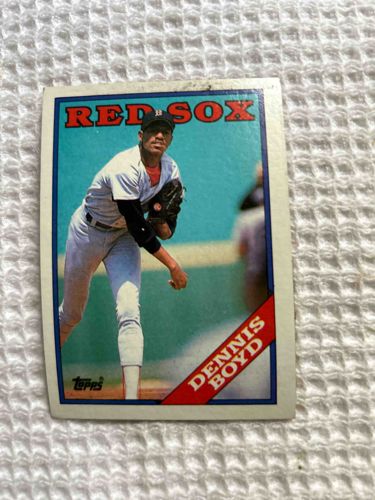
This item is a 1988 Topps baseball card featuring Dennis Boyd, a pitcher for the Boston Red Sox. The card is rectangular, made of light cardstock or paper, typical of baseball cards from this era. The front of the card displays a color action photograph of Dennis Boyd in a pitching motion. He is wearing a white uniform with light gray pants and a dark blue or black baseball cap with a red 'B' logo, presumably indicating the Boston Red Sox. A black fielding glove is visible on his left hand. The background of the photograph depicts a baseball field with green grass and what appears to be a light blue sky or stadium wall. At the top of the card, in a banner-like design, the words 'RED SOX' are printed in bold, red capital letters against a light blue background. The bottom right corner features a red diagonal banner with 'DENNIS BOYD' written in yellow capital letters. The iconic 'Topps' logo, a stylized 'T' within a circular design, is present in the lower left corner against the blue border. The edges of the card appear to show signs of wear, including some fraying and minor creasing, particularly visible on the top left and bottom edges. There is also some discoloration or dirt visible on the white border, especially on the top edges. The card's corners exhibit some softening and possible minor dings. The overall condition suggests that it has been handled and is not in mint condition. The card dates to the late 1980s, reflecting the common design aesthetics of Topps baseball cards from that period, characterized by vibrant photographic images and distinct team and player identification banners. The quality of printing appears to be standard for mass-produced sports cards of its vintage.
AI Appraisal Report
Upon my virtual examination of the 1988 Topps Dennis Boyd baseball card, I can provide a professional appraisal based on the visual information available. This is a common-era Topps card, mass-produced in significant quantities. The card's condition is a primary factor in its valuation, and from the description, it appears to be in 'Good' to 'Very Good' condition, not 'Mint'. I note signs of wear, including fraying, minor creasing, softening of corners, and some discoloration/dirt on the borders. These flaws significantly reduce its market value. Cards from 1988 are largely considered 'junk wax era' cards due to overproduction, which means even pristine examples of common players hold minimal value.
Market conditions for common 1988 Topps cards are very low. Comparables for non-star players like Dennis Boyd in this condition typically sell for under a dollar, often bundled with other cards. There is no significant demand for this specific card, nor is it rare. Dennis Boyd was not a Hall of Famer or a generational star, further limiting demand. The primary factors impacting its value negatively are its commonality, age (from an overproduced era), and the visible condition issues.
It is important to note that my authenticity verification is limited to the provided description. Without a physical inspection, I cannot verify the exact card stock, printing quality in hand, or detect any surface alterations not visible in a description. For full authentication and a definitive condition assessment, an in-person examination by a reputable grading service (e.g., PSA, SGC, Beckett) would be required. This would confirm details like gloss, print defects, precise corner wear, and any potential alterations or restoration. However, based on the description, the cost of such grading would likely far exceed the card's potential value.