AI estimate as of September 5, 2025 · verify with a professional before acting
AI-Generated · Verify before acting
Everything on this page is generated by AI for informational purposes only. AI can make mistakes — the AI may misidentify items or misattribute them (artist, maker, brand, designer, origin, era). This is not an official valuation and should not be used for insurance, sale, tax, estate, legal, or lending purposes — or any decision requiring a certified appraisal. It is not an authoritative claim about any person, brand, or rights holder — do not share or rely on it as a factual statement about a third party. Always consult qualified professionals before making financial decisions.
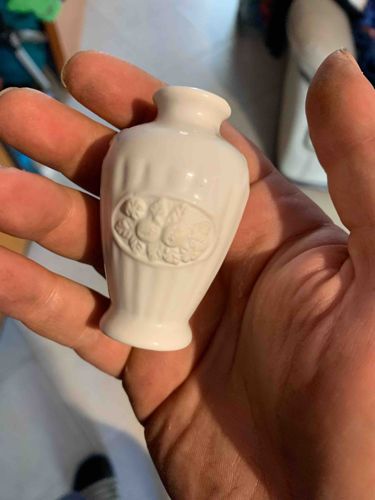
This is a miniature white ceramic vase, approximately 3-4 inches in height as suggested by its scale relative to the human hand holding it. The vase features a classic, somewhat bulbous body that tapers towards a flared neck and rim, and sits on a small round base. Its primary color is a uniform off-white or cream, consistent with unglazed or matte-finished ceramic. The surface is not glossy, suggesting either a bisque finish or a matte glaze. A notable feature is the ribbed or fluted texture running vertically along the sides of the vase, interrupted on one side by an oval-shaped raised relief medallion. This medallion prominently displays a fruit motif, specifically what appears to be clusters of grapes and possibly other fruits or leaves, rendered in a detailed, three-dimensional style. The craftsmanship appears to be good, with clean lines and well-defined sculptural elements. There are no immediately visible cracks, chips, or significant damage, though slight discoloration or residue is apparent on the thumb and palm holding the object, which might suggest handling or age, but not necessarily item damage. No discerning maker's marks or signatures are visible in the provided image. The style suggests a decorative, possibly collectible, piece from the mid-20th century to contemporary times, leaning towards a classical or traditional aesthetic due to the fruit motif and fluted design. Its small size indicates it is likely intended for decorative purposes, perhaps for tiny flowers or as part of a miniature collection.
AI Appraisal Report
Based on my visual examination of the provided image, this miniature white ceramic vase with a fruit motif appears to be in good condition. I observe no obvious chips, cracks, or significant damage. The surface has a matte finish, consistent with a bisque or unglazed ceramic, and the modeling of the fruit motif and fluted texture is clean and well-defined. However, limitations exist without a physical inspection; minor hairline cracks, repairs, or surface imperfections might not be visible in a 2D image. Authenticity, in terms of its origin or maker, cannot be definitively determined without a maker's mark or provenance documentation. Without this, it's difficult to distinguish it from similar mass-produced decorative items.
From a market perspective, miniature decorative ceramic vases, especially those without known makers or significant historical context, generally fall into the affordable collectibles category. Comparables on online marketplaces and at antique malls suggest a modest value. Demand for such pieces is moderate, primarily from collectors of miniature items or those seeking quaint decorative accents. Rarity is low as similar items were widely produced.
Factors impacting value include its good aesthetic condition and charming design, which make it appealing. However, the lack of a discernible maker's mark or historical significance, its small size limiting utility, and the commonality of the design temper its value. For full authentication and to ascertain its exact origin, a physical examination would be crucial to look for hidden marks, assess the ceramic body and glaze quality more closely, and potentially conduct scientific testing to determine age and composition if a specific origin were suspected. Provenance documentation, such as original sales receipts or family history, would also significantly aid in authentication and value assessment.