AI estimate as of December 2, 2025 · verify with a professional before acting
AI-Generated · Verify before acting
Everything on this page is generated by AI for informational purposes only. AI can make mistakes — the AI may misidentify items or misattribute them (artist, maker, brand, designer, origin, era). This is not an official valuation and should not be used for insurance, sale, tax, estate, legal, or lending purposes — or any decision requiring a certified appraisal. It is not an authoritative claim about any person, brand, or rights holder — do not share or rely on it as a factual statement about a third party. Always consult qualified professionals before making financial decisions.
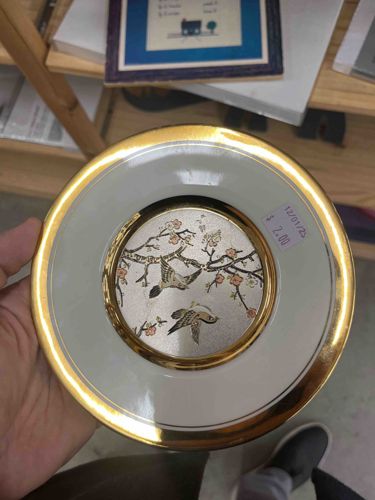
This item is a decorative ceramic saucer, likely intended for display or perhaps as a tea cup saucer, characterized by its elegant design and gilded accents. Physically, it measures approximately 5-6 inches in diameter based on the size relative to the hand holding it. The central part of the saucer features a circular depression adorned with an intricate, hand-painted or decal-applied scene. This scene depicts two birds perched within or flying near branches of a cherry blossom-like tree, rendered in a traditional East Asian artistic style. The background of this central medallion appears to be a muted silvery-gold or possibly platinum-colored metallic finish, which provides a shimmering contrast to the lighter cream or off-white color of the outer rim of the saucer. The entire edge of the saucer, as well as the inner ring separating the central motif from the outer rim, is heavily gilded with a bright, reflective gold, indicating high-quality application. The craftsmanship suggests it could be a piece of fine porcelain or bone china, given the delicate decoration and lustrous gold. There are no immediately visible condition issues such as chips, cracks, or significant wear to the gilding or internal motif, though minor surface wear might be present upon closer inspection. A price tag with "12/01/23 $2.00" is affixed to the outer rim, suggesting it was recently priced for sale, likely in a thrift store or second-hand market. The style points towards an mid-20th century to contemporary production, possibly influenced by Japanese or Chinese ceramic art. The high-gloss finish and detailed artwork indicate a piece of decorative appeal, likely manufactured with care.
AI Appraisal Report
Upon visual examination of this gilded decorative ceramic saucer, I assess its condition to be excellent. There are no visible chips, cracks, or significant wear to the gilding or the central avian and floral motif, suggesting careful handling or minimal use. The vibrant gold and clear detailing support this assessment. Its authenticity as a decorative ceramic is clear, though definitive manufacturer or origin details cannot be ascertained from imagery alone. The style, with its East Asian-inspired motif and heavy gilding, suggests a mid-20th century to contemporary production. The $2.00 price tag from 12/01/23 indicates a recent secondary market acquisition, likely from a thrift or charity shop, which aligns with its decorative, rather than antique, status.
Market conditions for such decorative ceramic saucers are generally modest. While beautifully crafted, items of this nature are mass-produced or produced in large batches. Comparables are similar decorative plates and saucers from non-specific manufacturers, which typically retail between $10 and $40, depending on condition and perceived aesthetic appeal. Demand for these pieces is driven more by interior decor trends than by collector interest or rarity. This particular saucer, while attractive, does not exhibit traits of a highly sought-after collectible or a rare artisan piece. Factors significantly impacting value are primarily its excellent condition and decorative quality. The lack of maker's marks or provenance limits its value to its aesthetic appeal.
Limitations in authenticity verification are significant without a physical examination. I cannot verify the type of ceramic (e.g., porcelain vs. bone china), the specific gilding material, or confirm whether the design is hand-painted or a decal without close inspection. The absence of a backstamp or signature makes pinpointing the exact origin or manufacturer impossible from images. To fully authenticate its origin, material composition, and potential artisan, an in-person examination for maker's marks, as well as forensic analysis of the ceramic and gilding, would be necessary.