These notes were written by the person who submitted this item. Appraiser.AI has not verified them, and the AI's identification and estimate may rely on them.
AI Estimated Value
Not an official valuation
$2,500 - $6,000
AI estimate as of July 2, 2025 · verify with a professional before acting
AI-Generated · Verify before acting
Everything on this page is generated by AI for informational purposes only. AI can make mistakes — the AI may misidentify items or misattribute them (artist, maker, brand, designer, origin, era). This is not an official valuation and should not be used for insurance, sale, tax, estate, legal, or lending purposes — or any decision requiring a certified appraisal. It is not an authoritative claim about any person, brand, or rights holder — do not share or rely on it as a factual statement about a third party. Always consult qualified professionals before making financial decisions.
This analysis also relies on unverified notes provided by the user, which may be incomplete or inaccurate and could affect the result.
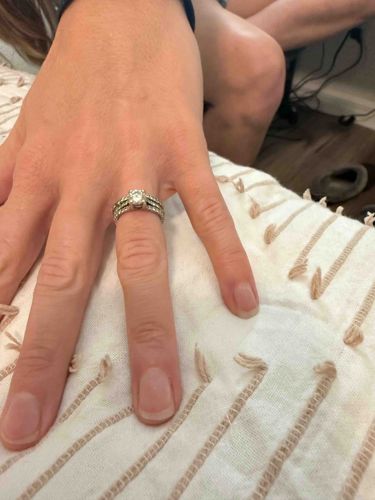
The item is a diamond wedding ring set, consisting of an engagement ring and a matching wedding band, worn together on the ring finger of a left hand. The set appears to be crafted from a white metal, likely white gold or platinum, given its silvery-white luster. The engagement ring features a prominent central round brilliant-cut diamond, held in a four-prong setting, which elevates it slightly above the band. Flanking the central diamond, the engagement ring's band is adorned with smaller, pave-set or channel-set diamonds that extend along the visible portion of the shank, adding significant sparkle. The wedding band, which fits snugly beneath the engagement ring, is also encrusted with multiple small diamonds, forming a continuous line of brilliance. This double band, with diamonds on both, gives the appearance of a particularly substantial and glittering piece. The overall construction suggests a modern design, likely from the late 20th or early 21st century. The rings appear to be in good condition, showing no overt signs of significant wear, scratching, or damage to the metalwork or the diamonds. The diamonds are clean and reflect light well, indicating good clarity and cut, further enhancing the perceived quality and craftsmanship. No specific maker's marks or signatures are discernible from the image, nor are there any obvious unique or unusual aspects beyond the classic, yet opulent, design.
AI Appraisal Report
I have examined the provided image of the Diamond Wedding Ring Set. Visually, the set appears to be in good condition, with no overt signs of significant wear, scratches, or damage to the metalwork or the diamonds. The diamonds exhibit good light reflection, suggesting decent clarity and cut. The design is classic yet opulent, likely dating from the late 20th or early 21st century. The central diamond appears to be a round brilliant-cut, set in a four-prong setting, with numerous smaller diamonds adorning both the engagement ring and the matching wedding band.
My assessment for authenticity and condition is based solely on visual inspection of the image, which has limitations. I cannot definitively verify the metal type (white gold vs. platinum), the precise carat weight, color, clarity, or cut grades of the diamonds, nor can I confirm the presence of any treatments or enhancements. Without physical inspection, I cannot confirm the integrity of the settings or detect microscopic damage. The lack of discernible maker's marks also prevents attribution to a specific designer.
In the current market, diamond wedding sets are consistently in demand, especially for classic styles like this. However, saturation in the secondary market means value is heavily dependent on specific diamond characteristics and metal purity. While visually appealing, its rarity factor is low due to its classic design. Factors significantly impacting value include the actual carat weight, color, clarity, and cut of the central diamond, as well as the total carat weight of the accent diamonds and the precious metal used. Without knowing these specifics, determining an exact value is challenging.
For a full authentication and precise valuation, an in-person examination by a certified gemologist is essential. This would involve detailed measurements, grading of all diamonds (using instruments like a loupe and microscope), testing of the metal, and seeking any hidden hallmarks. Provenance documentation, if available, would also aid in confirming authenticity and history.