These notes were written by the person who submitted this item. Appraiser.AI has not verified them, and the AI's identification and estimate may rely on them.
AI Estimated Value
Not an official valuation
$250 - $400
AI estimate as of August 24, 2025 · verify with a professional before acting
AI-Generated · Verify before acting
Everything on this page is generated by AI for informational purposes only. AI can make mistakes — the AI may misidentify items or misattribute them (artist, maker, brand, designer, origin, era). This is not an official valuation and should not be used for insurance, sale, tax, estate, legal, or lending purposes — or any decision requiring a certified appraisal. It is not an authoritative claim about any person, brand, or rights holder — do not share or rely on it as a factual statement about a third party. Always consult qualified professionals before making financial decisions.
This analysis also relies on unverified notes provided by the user, which may be incomplete or inaccurate and could affect the result.
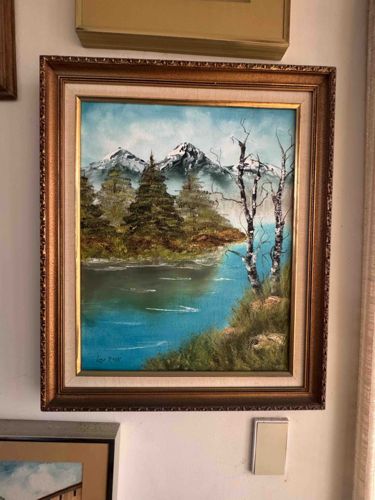
This is a framed oil painting depicting a serene mountain landscape scene. The painting features three prominent snow-capped mountains in the background under a pale blue sky. In the mid-ground, a dense cluster of evergreen trees, likely pines or spruces, lines the bank of a winding river or lake. To the right of the water, a grassy bank with darker green foliage leads up to two distinctive white-barked trees, resembling birch trees, with sparse, dark branches suggesting autumn or winter. The water is rendered in varying shades of blue, indicating depth or reflections. The brushstrokes appear to be visible, suggesting a textured application of paint, characteristic of oil or acrylic mediums. The painting is housed within a substantial wooden frame, likely gilded, with an ornate, possibly carved or molded, outer edge in a darker, perhaps bronze or antique gold, finish. Inside the ornate frame, there is a lighter colored, possibly linen or velvet, inner liner or matting that creates a visual separation before the painting itself. The overall condition appears to be good, with no obvious signs of significant damage, scratches, or discoloration visible in the provided image. The painting exhibits a traditional landscape style, possibly from the mid to late 20th century, given its aesthetic and framing. There appear to be faint signatures or markings in the bottom left corner of the painting, though they are not clearly legible. The craftsmanship of the frame suggests a well-finished piece, contributing to the overall presentation of the artwork.
AI Appraisal Report
Upon examining the provided images of this framed mountain landscape oil painting, my assessment is based on its visual characteristics. The piece presents a serene, traditional landscape, skillfully executed with visible, textured brushstrokes typical of oil on canvas. The composition, featuring snow-capped mountains, a river, and distinctive birch trees, is competently rendered. The painting appears to be in good condition, with no visible signs of cracking, flaking, or significant discoloration. Its style and framing suggest a mid to late 20th-century origin. The ornate, gilded frame with a linen liner is a significant contributor to the overall presentation and value, indicative of a professional framing choice.
The key factor limiting a definitive valuation is the illegible signature in the bottom left corner. Without a known artist, the work is valued as a decorative piece. The market for unsigned or 'school of' landscape paintings is broad, with values heavily dependent on aesthetic appeal, size, and execution quality. Comparable well-executed, unsigned decorative landscapes of this size and period typically sell in the low to mid-hundreds at auction or in secondary market galleries.
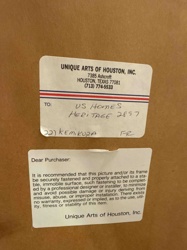
A precise authentication and valuation would require an in-person examination. This would allow for a closer inspection of the artist's signature, examination of the canvas reverse for labels or stamps, and an assessment of the paint's age and condition under magnification. Verifying the artist's identity would be the most critical step in determining if the value exceeds that of a purely decorative work.