AI Appraisal Estimate

AI-generated estimates · not official valuations

From the user

What was submitted

Photo and notes provided by the user — not generated by AI

Submitted item photo
Submitted photo · May 23, 2026

User's notes

No additional notes provided.

AI analysis below

AI appraisal

AI analysis & estimate

AI-Generated · Verify before acting

Everything below is generated by AI for informational purposes only. AI can make mistakes — the AI may misidentify items or misattribute them (artist, maker, brand, designer, origin, era). This is not an official valuation and should not be used for insurance, sale, tax, estate, legal, or lending purposes — or any decision requiring a certified appraisal. It is not an authoritative claim about any person, brand, or rights holder — do not share or rely on it as a factual statement about a third party. Always consult qualified professionals before making financial decisions.

Read the full disclaimer

AI Identification

·Not independently authenticated·Verify before acting

Vintage Navajo White Shell Squash Blossom Necklace and Ring Set

Native American Jewelry

AI Estimated Value

·Not an official valuation·Verify before acting

$1,450 - $1,850

As of May 23, 2026

AI Item Analysis

·AI can make mistakes·Verify before acting
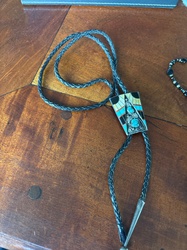
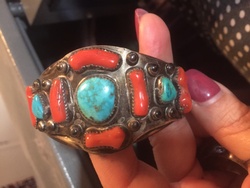
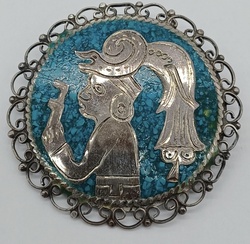
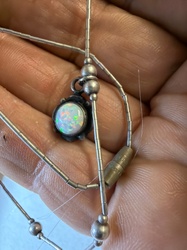
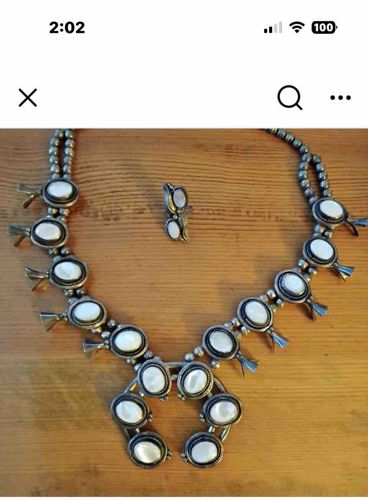
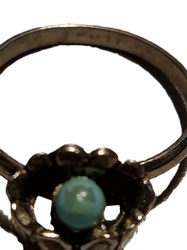
This is a vintage Southwestern squash blossom necklace and matching ring set, likely of Navajo (Dine) origin. The necklace is constructed with double rows of sterling silver 'bench beads' or 'Navajo pearls,' transitioning to a single row at the nape. It features twelve traditional squash blossom fluted charms, each set with an oval-shaped white shell cabochon (possibly white mother of pearl or white buffalo stone) held within a serrated bezel and accented with twisted wire rope detailing. The central focal point is a large 'Naja' pendant, a horseshoe-shaped cast silver piece featuring seven additional matching inset stones. The accompanying ring matches the style of the necklace, featuring two smaller oval stones in a vertical bypass or stacked arrangement. Physically, the silver displays a heavy, desirable dark patina in the recessed areas, which highlights the relief work of the beads and bezels. The stones appear to have a soft iridescent luster typical of natural shell. The craftsmanship indicates a mid-to-late 20th-century style period, approximately 1970s. While no maker's mark is visible in the photograph, the uniform construction of the beads and the precision of the bezel settings suggest high-quality artisanal work. Condition-wise, the set appears well-preserved with no missing stones or significant structural damage, though there is natural oxidation on the silver commensurate with age and use.
AI Appraisal Report

·AI can make mistakes·Verify before acting
I have conducted a visual examination of this Navajo-style squash blossom necklace and ring set. The craftsmanship reflects the formal repertoire of the 1970s 'Southwestern Jewelry Boom.' The set features high-quality silverwork with a natural grey-black oxidation patina. The use of white shell—possibly white mother of pearl or bleached white shell—instead of the more ubiquitous turquoise or coral makes this a distinctive collector's piece. The Naja is well-proportioned, and the beadwork shows the slight irregularities consistent with handmade 'bench beads.' Condition appears Excellent. I observe no cracked cabochons or loose bezels. The market for vintage Native American jewelry remains robust, with high demand for complete sets (matching necklace and ring). Comparables for mid-century Navajo sets of this caliber typically realize between $1,200 and $2,000 at specialized auction or retail. The rarity of the monochrome white-on-silver aesthetic adds a premium for contemporary interior-design-conscious collectors. However, there are limitations to this electronic appraisal. Without a maker’s mark, the attribution to an individual 'Diné' artisan is based on stylistic indicators alone. A physical inspection is required to verify the silver's fineness via acid testing and to confirm the stones are natural shell rather than synthetic composites. Full authentication would require provenance documentation, such as an original sales receipt from a reputable trading post or gallery, to distinguish it from high-quality imported reproductions produced during the same era.

Get your items appraised

Instant estimates of your treasures with AI-powered appraisals

Browse More Appraisals