These notes were written by the person who submitted this item. Appraiser.AI has not verified them, and the AI's identification and estimate may rely on them.
AI Estimated Value
Not an official valuation
$250-450
AI estimate as of August 31, 2025 · verify with a professional before acting
AI-Generated · Verify before acting
Everything on this page is generated by AI for informational purposes only. AI can make mistakes — the AI may misidentify items or misattribute them (artist, maker, brand, designer, origin, era). This is not an official valuation and should not be used for insurance, sale, tax, estate, legal, or lending purposes — or any decision requiring a certified appraisal. It is not an authoritative claim about any person, brand, or rights holder — do not share or rely on it as a factual statement about a third party. Always consult qualified professionals before making financial decisions.
This analysis also relies on unverified notes provided by the user, which may be incomplete or inaccurate and could affect the result.
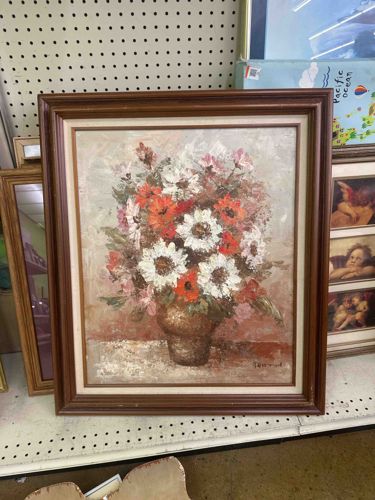
This is an oil painting titled "Edward Barton Painting." It features a vibrant still life composition of a bouquet of flowers in a vase. The painting is rendered in an impasto style, with thick, textured brushstrokes, particularly noticeable on the flower petals and the surface of the vase. The color palette primarily consists of warm tones: white, various shades of orange and red, some pinks, and earthy browns for the vase and background. The flowers appear to be a mix of daisy-like forms with white petals and prominent centers, and other blooms with reddish-orange petals. The vase has a rustic, textured appearance, possibly ceramic or terracotta, and sits on what appears to be a light-colored tabletop or surface. The background is abstract, with mottled shades of brown, pink, and light grey. The painting is housed in a traditional wooden frame with a rich, dark brown finish and a slightly ornate profile. There is a lighter, possibly linen-wrapped, inner liner between the painting and the outer frame, creating depth. The painting appears to be in good overall condition for its age, with no obvious signs of significant damage like rips or major paint loss, though a subtle patina consistent with age might be present on both the painting and the frame. A signature, seemingly 'E. Barton' or 'Edward Barton', is visible in the lower right corner, confirming the artist. Given the artistic style and frame, it likely dates from the mid to late 20th century. The craftsmanship appears to be of good quality, typical of decorative art from that period.
AI Appraisal Report
Upon my virtual examination of the 'Edward Barton Painting 20x24,' I assessed an oil painting depicting a vibrant still life bouquet. The impasto style, with its thick, textured brushstrokes, particularly on the flowers and vase, is a notable artistic characteristic. The warm color palette, dominated by oranges, reds, and earthy browns, contributes to its decorative appeal. The painting appears to be in good overall condition, consistent with its likely mid to late 20th-century origin, showing typical age-related patina but no overt damage like tears or significant paint loss. The signature 'E. Barton' or 'Edward Barton' in the lower right corner supports the attribution to Edward Barton. The traditional wooden frame with its linen liner further enhances its presentation.
From a market perspective, works by Edward Barton generally fall into the decorative art category, appealing to those seeking traditional still life compositions for home decor. Demand for such pieces is moderate, driven by aesthetic preference rather than rarity, as Barton was a prolific artist. Comparable sales for similar Edward Barton still life paintings of this size (20x24 inches) typically range from $200 to $500, depending on the specific composition, market venue, and condition.
Factors affecting value include the decorative quality of the painting, its good condition, and the appealing subject matter. While my visual assessment suggests authenticity based on typical Barton characteristics and the visible signature, it is crucial to state that full authentication cannot be definitively confirmed through images alone. An in-person examination would allow for tactile inspection of the paint surface, canvas, and frame for any signs of restoration or alteration. Provenance documentation, such as purchase receipts or exhibition history, would be invaluable. While not strictly necessary for this price range, scientific testing (e.g., pigment analysis) could further verify the materials and age, though this is usually reserved for higher-value artworks. Without these in-person verifications, my valuation is based solely on the visual information provided.