AI estimate as of August 17, 2025 · verify with a professional before acting
AI-Generated · Verify before acting
Everything on this page is generated by AI for informational purposes only. AI can make mistakes — the AI may misidentify items or misattribute them (artist, maker, brand, designer, origin, era). This is not an official valuation and should not be used for insurance, sale, tax, estate, legal, or lending purposes — or any decision requiring a certified appraisal. It is not an authoritative claim about any person, brand, or rights holder — do not share or rely on it as a factual statement about a third party. Always consult qualified professionals before making financial decisions.
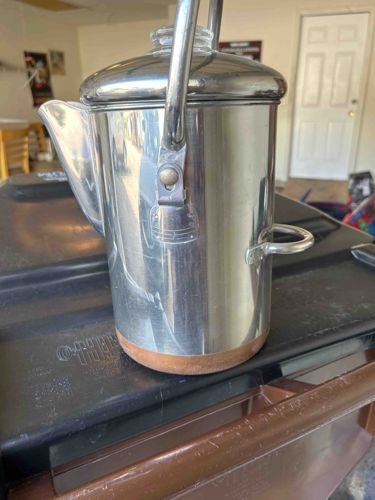
This item is a vintage-style, cylindrical coffee or tea pot, likely intended for camping or outdoor use due to its robust construction and integrated handle. It is primarily constructed from polished stainless steel, giving it a bright, reflective, and somewhat worn metallic sheen. The main body is a tall cylinder with a narrow, angled spout typical of a pouring vessel. A prominent, swing-out bail handle made of the same stainless steel is attached to the upper sides of the pot with riveted or similarly fastened metal brackets. One of these brackets appears to have a small, raised circular element, possibly a decorative cap or part of the fastening mechanism. The base of the pot has a distinct, lighter-colored band, suggestive of copper, brass, or another contrasting metal, or possibly a reinforced bottom for heat distribution. The lid is also stainless steel, with a slightly domed profile and a small, flatted knob attached in the center for lifting. On the side opposite the spout, there's a small, fixed metal ring, which might serve as an additional handle or an attachment point. The surface of the stainless steel shows signs of use, including scuffs, scratches, and minor smudges, indicating some wear consistent with its likely age and purpose. There are no obvious dents or major deformations visible, suggesting it's in reasonably good condition for a used item. The craftsmanship appears functional and utilitarian, with clean seams and well-attached components. There are no discernible maker's marks or signatures visible from the provided image, making it difficult to pinpoint a specific manufacturer or precise age. However, its design aesthetic suggests an age anywhere from the mid-20th century to modern retro-inspired pieces.
AI Appraisal Report
I have examined the Vintage Stainless Steel Camping Coffee/Tea Pot based on the provided image. My assessment of its condition is "good used." The stainless steel construction appears robust, exhibiting typical wear consistent with its likely use in outdoor settings, including scuffs and scratches. Crucially, there are no visible major dents or deformations, which speaks to its durability and careful handling. The integrated bail handle and lid appear fully functional.
From a market perspective, comparable vintage stainless steel camping items of this type, especially those with a distinctive base (potentially copper or brass-clad for heat distribution, adding to its appeal), generally fall into a niche collectibles market. While not high-value antiques, there's a steady demand from camping enthusiasts, collectors of vintage outdoor gear, and those seeking durable, retro-styled kitchenware. Rarity is moderate; while many stainless steel pots exist, one in this specific style and condition is less common than a modern equivalent. Factors impacting value include its good utilitarian condition, classic design, and potential for a unique base material. The absence of discernible maker's marks, however, limits its value as a highly sought-after brand item.
It is important to state the limitations of this appraisal. Authenticity, especially regarding the age and the exact material of the base, cannot be definitively verified from images alone. A physical examination would allow me to inspect the seams, rivets, and material composition more closely, and confirm the specific metal of the contrasting band at the base (e.g., copper, brass, or simply a different finish). Provenance documentation, though unlikely for an item of this type, would provide historical context. Scientific testing is not typically applied to items of this value but could confirm material composition if needed for high-stakes authentication.