AI Appraisal Estimate

AI-generated estimates · not official valuations

From the user

What was submitted

Photo and notes provided by the user — not generated by AI

Submitted item photo
Submitted photo · July 18, 2026

User's notes

No additional notes provided.

AI analysis below

AI appraisal

AI analysis & estimate

AI-Generated · Verify before acting

Everything below is generated by AI for informational purposes only. AI can make mistakes — the AI may misidentify items or misattribute them (artist, maker, brand, designer, origin, era). This is not an official valuation and should not be used for insurance, sale, tax, estate, legal, or lending purposes — or any decision requiring a certified appraisal. It is not an authoritative claim about any person, brand, or rights holder — do not share or rely on it as a factual statement about a third party. Always consult qualified professionals before making financial decisions.

Read the full disclaimer

AI Identification

·Not independently authenticated·Verify before acting

Talavera-style or Portuguese-style hand-painted ceramic bottle

Ceramics and Pottery

AI Estimated Value

·Not an official valuation·Verify before acting

$100 - $250

As of July 18, 2026

AI Item Analysis

·AI can make mistakes·Verify before acting
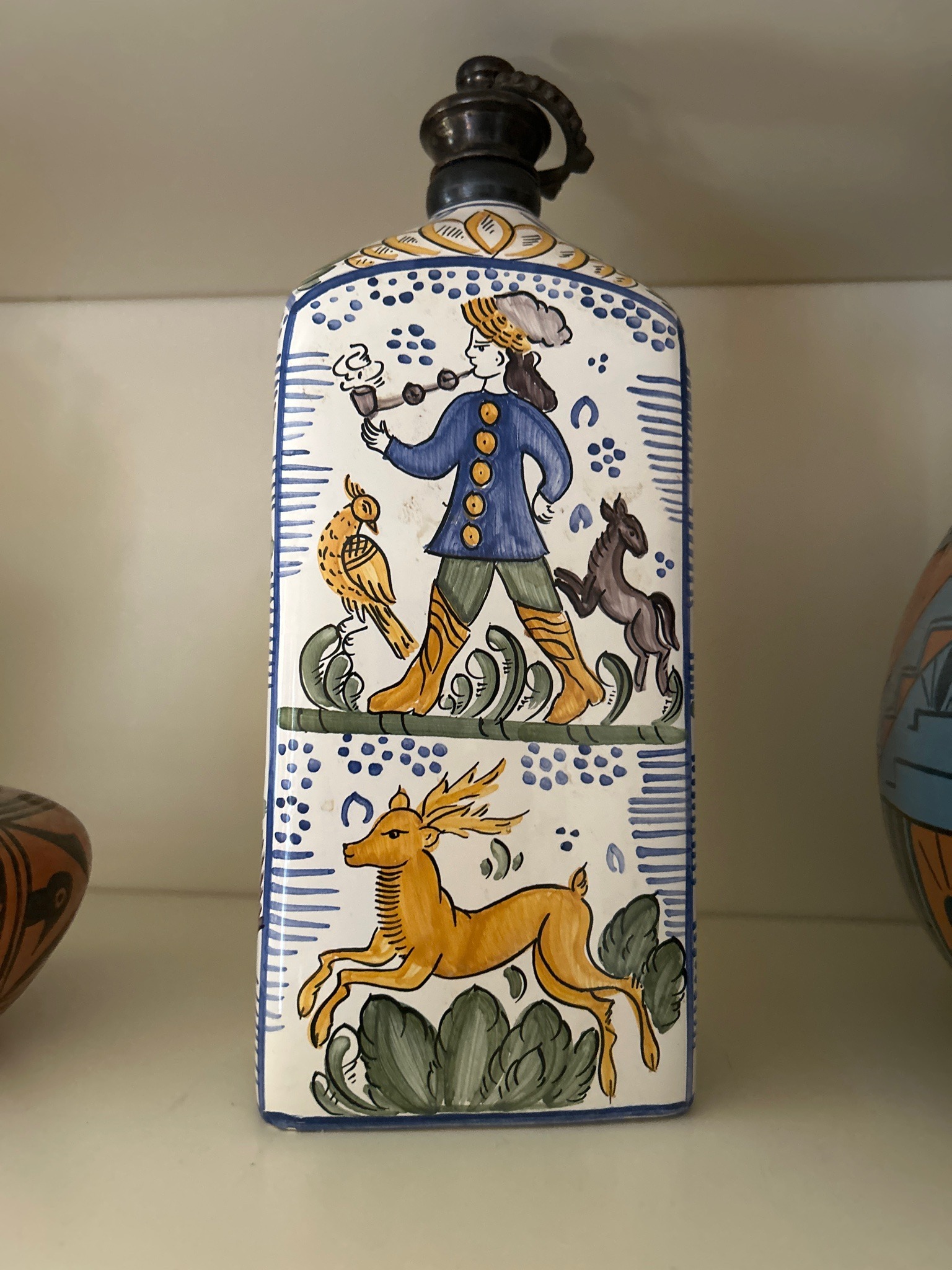
This item is a rectangular ceramic bottle with a slightly tapered shoulder, appearing to be crafted from glazed pottery. The vessel features a cream or off-white background decorated with hand-painted folk art motifs in blue, yellow, green, and manganese/black. The front facade is divided into two pictorial registers. The upper register depicts a figure in a blue coat and yellow boots smoking a pipe, flanked by a bird and a small animal (possibly a dog or donkey). The lower register features a leaping stag or deer amidst green foliage. The sides are adorned with blue horizontal banding. The bottle is capped with a dark, possibly pewter or metallic screw-top lid with a decorative loop. Stylistically, the artwork is consistent with 20th-century decorative majolica techniques, specifically those seen in Spanish Talavera de la Reina or Portuguese Coimbra pottery. No maker's marks or signatures are visible in the image to confirm a specific kiln or artist; the identification is based on visual motifs and fabrication style. The condition appears fair with visible crazing on the glaze surface and some potential minor wear along the edges, which is typical for earthenware of this age.

AI Appraisal Report

·AI can make mistakes·Verify before acting
I have examined the image provided of this hand-painted ceramic bottle. Based on what I can see, the vessel exhibits stylistic traits consistent with 20th-century decorative majolica, specifically the folk art traditions of Spanish Talavera de la Reina or Portuguese Coimbra pottery. This identification is a working hypothesis based on the figural motifs, such as the pipe-smoking figure and leaping stag, as well as the blue, yellow, and manganese color palette. I cannot verify from a photo if there are any faint maker's marks on the underside or beneath the metallic cap, which appears to be pewter or a similar alloy. The value estimate is based on the assumption that this is a 20th-century earthenware piece handcrafted in one of these European traditions. Objects of this type are generally sought after by collectors of Mediterranean folk art and rustic kitchenware. The presence of glaze crazing is typical for earthenware, though I cannot confirm the depth of these fissures or if there are structural repairs without a physical inspection. This estimate reflects the current market for authentic regional pieces; however, if physical examination or provenance documentation were to reveal this is a more modern, mass-produced 'in the style of' reproduction from a factory outside these traditional regions, the value would likely fall below $50. To confirm the origin and age, an in-person examination by a ceramics specialist would be required to analyze the clay body composition, the specific firing technique, and the authenticity of the metal hardware. Final valuation would be contingent upon these findings and the verification of the kiln's geographic origin.

Get your items appraised

Instant estimates of your treasures with AI-powered appraisals

Browse More Appraisals