AI estimate as of November 28, 2025 · verify with a professional before acting
AI-Generated · Verify before acting
Everything on this page is generated by AI for informational purposes only. AI can make mistakes — the AI may misidentify items or misattribute them (artist, maker, brand, designer, origin, era). This is not an official valuation and should not be used for insurance, sale, tax, estate, legal, or lending purposes — or any decision requiring a certified appraisal. It is not an authoritative claim about any person, brand, or rights holder — do not share or rely on it as a factual statement about a third party. Always consult qualified professionals before making financial decisions.
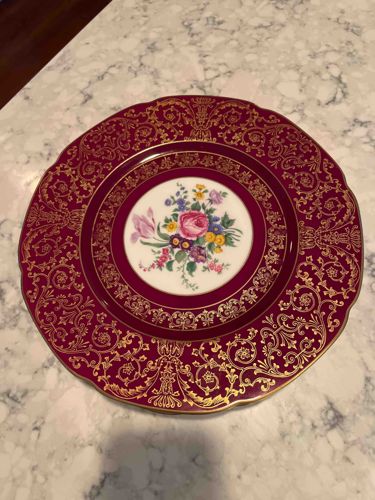
This exquisite decorative plate features a rich, deep maroon field with opulent gold gilding and a central floral motif. The plate is circular, but its outer rim is sculpted with a gentle, undulating scallop design, adding an element of classic elegance. The primary color of the plate's body is a striking, almost ruby-red maroon, which serves as a luxurious backdrop for the intricate gold detailing. The gold work is extensive, covering the entire outer rim in a dense, filigree-like pattern of scrolls, acanthus leaves, and neoclassical motifs. This pattern is consistent and appears to be hand-applied or a high-quality transfer, indicating careful craftsmanship. There's a thinner gold band just inside the maroon field, encircling a narrower maroon border, which then frames the central medallion. The medallion itself is a pristine white, serving as a bright canvas for a vibrant bouquet of flowers. The floral arrangement includes a prominent pink rose at its center, surrounded by smaller blue, yellow, and purple blossoms, along with green foliage. The colors of the flowers are bright and vivid, suggesting a porcelain paint application. The plate exhibits a high-gloss finish, which enhances the luminosity of both the maroon and the gold. There are no immediately visible chips, cracks, or significant wear to the gilding or painted areas, suggesting it has been well-preserved, likely as a display piece rather than for daily use. The overall aesthetic points to a late 19th to mid-20th-century European decorative style, possibly inspired by Sèvres or Dresden porcelain, known for their elaborate gold and floral designs. The quality of the gilding and the delicate floral painting indicates a piece of significant decorative value.
AI Appraisal Report
Upon visual examination of the provided image of the Lustrous Maroon and Gold Floral Decorative Plate, I assess its condition as excellent. The high-gloss finish is intact, and there are no visible chips, cracks, or significant wear to the gilding or painted designs. This suggests it has served primarily as a display piece. The intricate gold work, the vibrant floral motif on a white medallion, and the rich maroon field are characteristic of late 19th to mid-20th century European decorative styles, possibly inspired by renowned porcelain manufacturers like Sèvres or Dresden.
From the image, the pattern appears to be consistent and well-executed, indicating either hand-application or a high-quality transfer. However, without physical inspection, I cannot confirm the exact application method or the manufacturer. The absence of maker's marks, which would typically be on the reverse side, prevents definitive authentication of origin or specific artisan. Such marks significantly impact value.
Market conditions for decorative plates of this style vary widely. While pieces from top-tier manufacturers with clear provenance can fetch substantial sums, general decorative plates without such identification tend to command more modest prices. Comparable items in excellent condition, without specific attribution, typically fall into the $100-$200 range in the current market. Demand is steady for well-preserved aesthetic pieces, but rarity is challenging to determine without knowing the manufacturer and production numbers.
Factors impacting value positively are its excellent condition and elaborate aesthetic. Negatively impacting value are the lack of verifiable maker's marks and definitive historical provenance. For full authentication and a more precise valuation, aphysical examination is essential to inspect for maker's marks, assess the quality of materials and craftsmanship firsthand, and potentially conduct scientific testing to determine age and composition. Provenance documentation, if available, would also be crucial.