AI estimate as of July 5, 2025 · verify with a professional before acting
AI-Generated · Verify before acting
Everything on this page is generated by AI for informational purposes only. AI can make mistakes — the AI may misidentify items or misattribute them (artist, maker, brand, designer, origin, era). This is not an official valuation and should not be used for insurance, sale, tax, estate, legal, or lending purposes — or any decision requiring a certified appraisal. It is not an authoritative claim about any person, brand, or rights holder — do not share or rely on it as a factual statement about a third party. Always consult qualified professionals before making financial decisions.
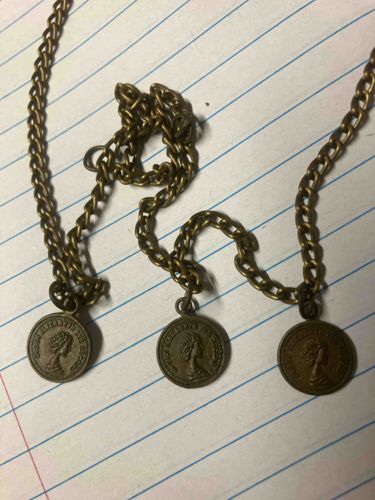
The image displays three antique or vintage-style charm bracelets, possibly intended as necklaces or necklace components, each featuring a linked chain and a circular medal or coin-like pendant. The chains appear to be made of a bronzed or antiqued brass-tone metal, exhibiting a dark, aged patina consistent with exposure or intentional finishing. The linking style varies; the leftmost chain appears to be a tightly woven foxtail or braid chain, while the other two have more open, classic curb-link or rolo-link designs. All chains show some degree of oxidation and darkening in the crevices, contributing to their aged appearance. Each circular pendant is attached to its respective chain via a small jump ring. The pendants themselves are approximately the size of a small coin and feature a raised relief portrait of a female figure, likely Queen Elizabeth II, given the visible inscription 'QUEEN ELIZABETH THE SEC'. The details on the pendants are somewhat obscured by the patina and resolution but suggest a classical profile bust. There are visible signs of wear, including surface scratches and darkening, particularly on the raised areas of the pendants. The overall condition suggests moderate use and age, with the patina being a significant characteristic rather than a flaw. The craftsmanship appears to be commercial grade, indicative of mass production rather than artisanal work. These items likely date from the mid-to-late 20th century, consistent with the reign of Queen Elizabeth II and the depicted coin design style. They could potentially be souvenir items or fashion jewelry from that era.
AI Appraisal Report
I have carefully examined the image of these three Queen Elizabeth II portrait charm bracelets/necklace components. Visually, they appear to be late 20th-century costume jewelry, likely souvenir or novelty items. The chains vary in style and show significant patination, consistent with aged base metal, possibly brass or a brass alloy. The circular pendants clearly depict a profile of Queen Elizabeth II, with legible "QUEEN ELIZABETH THE SEC" inscriptions, suggesting they emulate British coinage from her reign. Condition-wise, they exhibit expected wear, surface scratching, and a desirable dark patina, which enhances their vintage appeal. The craftsmanship appears commercial grade, typical of mass-produced fashion accessories from the era.
From a market perspective, these types of pieces generally fall into the costume jewelry category rather than fine jewelry. Demand for such items is moderate, driven primarily by collectors of vintage costume jewelry, royal memorabilia, or those seeking unique accessories. They are not intrinsically rare; similar items can be found in antique malls, flea markets, and online platforms. The value is largely aesthetic and sentimental, not based on precious metal content or gemstone rarity. Factors impacting value include their charming vintage aesthetic and their association with a historical figure. The primary limitation to a full authentication and valuation from images alone is the inability to determine the exact metal composition or confirm manufacturing marks that might indicate a specific maker or origin. A physical inspection would allow for tactile assessment, a closer look at potential hallmarks or maker's marks, and a more precise determination of material, though these are unlikely to be precious metals. Provenance documentation, if available, could add minor historical value but is rarely found for items of this nature.