AI Appraisal Estimate

AI-generated estimates · not official valuations

From the user

What was submitted

Photo and notes provided by the user — not generated by AI

Submitted item photo
Submitted photo · May 25, 2026

User's notes

No additional notes provided.

AI analysis below

AI appraisal

AI analysis & estimate

AI-Generated · Verify before acting

Everything below is generated by AI for informational purposes only. AI can make mistakes — the AI may misidentify items or misattribute them (artist, maker, brand, designer, origin, era). This is not an official valuation and should not be used for insurance, sale, tax, estate, legal, or lending purposes — or any decision requiring a certified appraisal. It is not an authoritative claim about any person, brand, or rights holder — do not share or rely on it as a factual statement about a third party. Always consult qualified professionals before making financial decisions.

Read the full disclaimer

AI Identification

·Not independently authenticated·Verify before acting

Hand-Carved Green Stone Turtle Fetish

Collectibles / Lapidary Art & Figurines

AI Estimated Value

·Not an official valuation·Verify before acting

$25.00 - $45.00

As of May 25, 2026

AI Item Analysis

·AI can make mistakes·Verify before acting
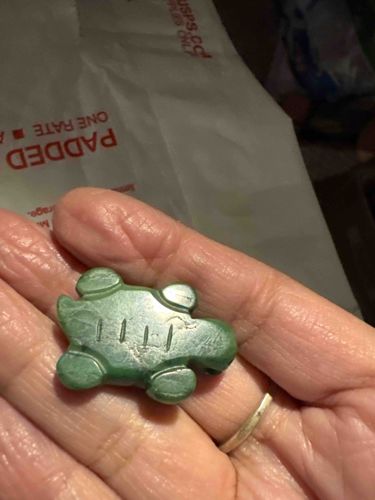
This item is a small, hand-carved animal fetish depicting a turtle, likely measuring approximately 1 to 1.5 inches in length based on its scale in the palm of a hand. The figurine is crafted from a forest green semi-translucent stone, which appears to be nephrite jade, aventurine, or a similar regional serpentine variety. The carving is stylized and folk-art in nature, featuring a rounded head, four stubby flippers, and a short tail. Notable markings include four vertical linear incisions across the center of the carapace, intended to represent shell scutes. The stone displays a waxy to vitreous luster with a mottled color distribution, showing lighter green inclusions and darker internal veining. In terms of condition, the piece shows significant signs of age and handled wear, including multiple surface abrasions, small nicks on the flippers, and a noticeable white-toned scratch or surface fissure near the neck area. There are no visible maker's marks or signatures, which is common for artisanal folk carvings. The craftsmanship suggests a mid-to-late 20th-century origin, possibly inspired by Zuni or broader Southwestern Native American fetish traditions, though it lacks the intricate details of high-end contemporary lapidary work. The overall quality is characteristic of a souvenir or devotional object, with a smooth, tactile patina developed through use or carrying as a pocket stone.

AI Appraisal Report

·AI can make mistakes·Verify before acting
I have carefully examined the provided images of this hand-carved green stone turtle fetish. The piece appears to be carved from a variety of serpentine or nephrite jade, showing a characteristic waxy luster and mossy inclusions. My physical assessment reveals a stylized, folk-art execution consistent with mid-to-late 20th-century production. The carving lacks the refinement and specific material inlay (such as turquoise eyes) often found in high-grade Zuni masterworks, suggesting it was likely produced as a souvenir or for personal devotional use. The condition exhibits moderate handled wear, including surface abrasions and a notable fissure near the neck, which are typical for stones carried as 'pocket pieces' but do reduce the collectible value compared to pristine specimens. The market for generic stone fetishes is currently saturated, with significant competition from contemporary imports. Comparables sold at retail and online auctions for similar sizes and materials generally fall within the $20 to $50 range. Critically, a definitive mineralogical identification between aventurine, bowenite, or nephrite is impossible from photographs alone and would require a specific gravity test or Mohs hardness scratch test. Furthermore, without a signed artist's mark or documented provenance (such as a gallery receipt or collection history), I cannot attribute this piece to a specific Native American artisan or tribe. For a full authentication, I would recommend an in-person inspection to verify the carving techniques and confirm the stone's origin.

Get your items appraised

Instant estimates of your treasures with AI-powered appraisals

Browse More Appraisals