These notes were written by the person who submitted this item. Appraiser.AI has not verified them, and the AI's identification and estimate may rely on them.
AI Estimated Value
Not an official valuation
$2,800-4,500
AI estimate as of October 12, 2025 · verify with a professional before acting
AI-Generated · Verify before acting
Everything on this page is generated by AI for informational purposes only. AI can make mistakes — the AI may misidentify items or misattribute them (artist, maker, brand, designer, origin, era). This is not an official valuation and should not be used for insurance, sale, tax, estate, legal, or lending purposes — or any decision requiring a certified appraisal. It is not an authoritative claim about any person, brand, or rights holder — do not share or rely on it as a factual statement about a third party. Always consult qualified professionals before making financial decisions.
This analysis also relies on unverified notes provided by the user, which may be incomplete or inaccurate and could affect the result.
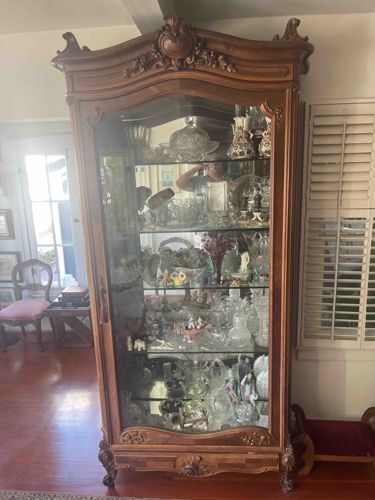
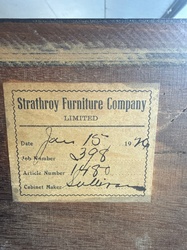
This exquisite piece is an antique French Rococo Revival curio cabinet, constructed primarily of a warm, reddish-brown hardwood, likely walnut or mahogany, with a rich, polished finish. It stands tall and slender, featuring elegant curves and intricate hand-carved detailing characteristic of the Rococo style, reinterpreted in a later period. The top crest is particularly ornate, showcasing a central cartouche flanked by scrolling acanthus leaves and floral motifs. The overall shape of the cabinet is bombe-fronted, with a gracefully curved glass door that wraps around the sides, allowing for maximum visibility of the displayed contents. The glass appears to be original and free from obvious cracks or significant scratches, though precise condition is difficult to ascertain from the image alone. Internally, the cabinet is fitted with multiple glass shelves, designed to hold and showcase decorative items, which currently hold a collection of crystal and glass objects. The back of the cabinet appears to be mirrored, enhancing the sparkle and depth of the display. The base of the cabinet echoes the ornate carving of the crest, with a pronounced apron featuring shell and scroll motifs, supported by four cabriole legs ending in carved feet. There are no readily visible maker's marks or signatures from the provided image. The overall condition appears to be excellent for an antique piece, with a well-maintained patina and no apparent significant damage or repairs, although minor wear consistent with age and use (e.g., slight abrasions to the finish, minor joint separation) would be expected. The craftsmanship indicates a high-quality furniture piece, likely dating from the late 19th to early 20th century. Its unique blend of functional display and decorative elegance makes it a statement piece.
AI Appraisal Report
Upon examining the provided image and description of this exquisite French Rococo Revival Curio Cabinet, I assess it to be a high-quality antique. The construction appears to be a durable hardwood, likely walnut or mahogany, with a rich finish. The intricate hand-carved detailing, bombe-front shape, and gracefully curved glass door are hallmarks of the Rococo Revival style, placing its likely creation in the late 19th to early 20th century. The mirrored back and glass shelving enhance its function as a display piece.
Authenticity, based on visual inspection, appears strong for an antique of this period. The patina and stylistic elements are consistent with documented examples. The condition appears to be excellent for its age, with no obvious major damage from the image. However, a physical inspection would be crucial to confirm the absence of subtle repairs, structural weaknesses, or significant surface wear not visible photographically. Specific areas of concern for in-person examination would include the integrity of all carved elements, the condition of wood joints, and any potential hairlines or scratching on the original glass.
Market conditions for quality Rococo Revival furniture remain stable. There is a consistent demand for well-preserved, ornate display cabinets that serve as statement pieces in both traditional and eclectic interiors. While Rococo Revival is not as rare as true 18th-century Rococo, pieces with such fine carving and excellent apparent condition are less common. Comparables on the secondary market suggest similar large, ornate cabinets in excellent condition fetch prices in this range, particularly those with a curved glass and mirrored interior.
Factors impacting value positively include the excellent apparent condition, intricate carving, full curved glass door, and mirrored interior. The lack of visible maker's marks is common for furniture of this period and doesn't significantly detract from value for a decorative piece of this caliber. To achieve full authentication, especially regarding the wood species and originality of all components, an in-person examination by a furniture conservator, along with any provenance documentation from the owner, would be highly beneficial.