AI estimate as of November 30, 2025 · verify with a professional before acting
AI-Generated · Verify before acting
Everything on this page is generated by AI for informational purposes only. AI can make mistakes — the AI may misidentify items or misattribute them (artist, maker, brand, designer, origin, era). This is not an official valuation and should not be used for insurance, sale, tax, estate, legal, or lending purposes — or any decision requiring a certified appraisal. It is not an authoritative claim about any person, brand, or rights holder — do not share or rely on it as a factual statement about a third party. Always consult qualified professionals before making financial decisions.
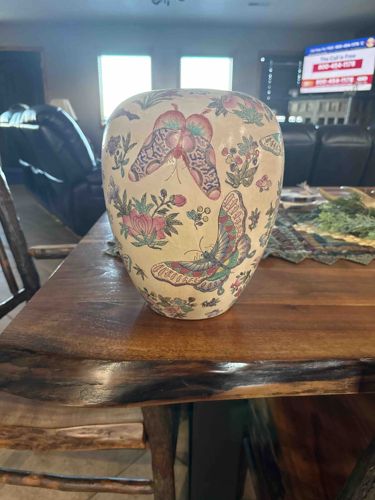
This item is a decorative ginger jar, likely made from ceramic or porcelain, exhibiting a traditional 'Famille Rose' style polychrome enamel decoration. The jar features a rounded, ovoid body that tapers slightly towards a narrow mouth, which is not fully visible but suggested by the form. The base color of the jar appears to be a light, creamy yellow or off-white, providing a warm background for the vibrant hand-painted motifs. The primary decorative elements are several large, stylized butterflies rendered in shades of pink, purple, green, and red, with intricate detailing on their wings. These butterflies are interspersed with delicate floral and botanical designs, including blossoms in pink and red hues, and green foliage. The painting style suggests fine brushwork, indicative of quality craftsmanship. There are no clearly visible manufacturing marks or signatures, though these are often on the underside. Given the style, it likely dates from the late 19th to mid-20th century, consistent with a period of prolific production of such wares for export. The overall condition appears good from the visible angles, with no obvious cracks, chips, or significant paint loss, though minor surface wear or crazing might be present upon closer inspection. The colors remain relatively vibrant, suggesting good preservation. This piece serves as a decorative art object, commonly used for storage or as a standalone display item.
AI Appraisal Report
Upon visual examination of the provided image, I have assessed this Famille Rose ginger jar. The piece presents as a well-executed example of Chinese export porcelain, featuring a popular butterfly and floral motif. The vibrant polychrome enamels and delicate brushwork are characteristic of wares produced from the late Qing Dynasty to the Republic period (circa late 19th to mid-20th century). From the image, the jar appears to be in very good condition, with no visible chips, cracks, or significant wear to the enamel decoration. The colors remain bright, suggesting it has been well cared for.
The market for Famille Rose porcelain of this era remains steady. While not exceptionally rare, high-quality decorative pieces with appealing motifs like this one are consistently in demand. Comparable ginger jars from this period, without significant provenance or a known maker's mark, typically sell in the $350 to $550 range at auction and in retail settings. The value is primarily driven by its decorative quality, condition, and size. The absence of a lid, which is common for ginger jars, may slightly temper the higher end of the value range.
It is crucial to note the limitations of this appraisal, as it is based solely on photographic evidence. A definitive authentication would require in-person examination to assess the texture of the glaze, the weight of the porcelain, the quality of the footrim, and to search for any maker's marks or period marks on the underside. Without physical inspection, I cannot rule out the possibility of it being a later, high-quality reproduction. Full confirmation of its age would benefit from provenance documentation or comparison with verified museum examples.