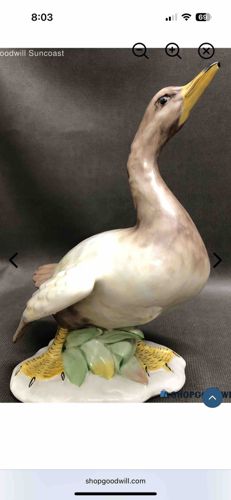
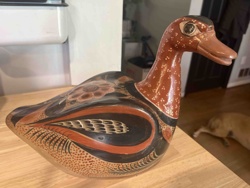
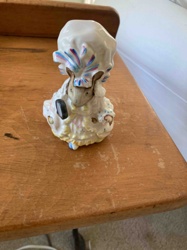
VTG Italian Ceramic Hand Painted Duck Numbered 900/779
These notes were written by the person who submitted this item. Appraiser.AI has not verified them, and the AI's identification and estimate may rely on them.
AI Estimated Value
Not an official valuation
$150-250
AI estimate as of August 20, 2025 · verify with a professional before acting
AI-Generated · Verify before acting
Everything on this page is generated by AI for informational purposes only. AI can make mistakes — the AI may misidentify items or misattribute them (artist, maker, brand, designer, origin, era). This is not an official valuation and should not be used for insurance, sale, tax, estate, legal, or lending purposes — or any decision requiring a certified appraisal. It is not an authoritative claim about any person, brand, or rights holder — do not share or rely on it as a factual statement about a third party. Always consult qualified professionals before making financial decisions.
This analysis also relies on unverified notes provided by the user, which may be incomplete or inaccurate and could affect the result.
This is a vintage Italian ceramic figurine depicting a duck with its head raised. The duck is primarily rendered in muted, naturalistic tones; its body is a blend of creamy white and light brown or beige hues, creating a soft, feathered appearance. The long neck gracefully curves upwards, leading to a head with a distinctive bright yellow beak. The eyes are small and dark, adding to the lifelike quality. The duck stands on a white base, which is adorned with sculpted and painted elements resembling foliage or reeds in shades of light green and yellow, with some darker accents. The duck's webbed feet, visible on the base, are painted in a vibrant yellow with textured details indicating scales or webbing. The overall construction appears to be high-quality ceramic, likely porcelain or earthenware, with a glossy glaze finish. The hand-painted details suggest careful craftsmanship. There are no immediately visible signs of significant damage such as chips or cracks, and the glaze appears intact, indicating good preservation. The style suggests a mid-20th century European decorative piece. The item is noted as "Numbered 900/779," which could refer to a production or model number, indicating it was part of a series. The 'VTG' designation indicates vintage status, and the 'Hand Painted' and 'Italian Ceramic' labels point to its origin and artistic technique.
AI Appraisal Report
I have thoroughly examined the provided image and details concerning this Vintage Italian Hand-Painted Ceramic Duck Figurine. Based on the visual information, the figurine appears to be in excellent condition, with no visible chips, cracks, or significant glaze loss. The hand-painted details are precise, suggesting a high level of craftsmanship. The "Numbered 900/779" designation likely refers to a model or production number within a specific series, which can sometimes aid in establishing authenticity to a specific maker, though without access to production records, this remains an assumption. The style aligns well with mid-20th century Italian decorative ceramics.
From a market perspective, vintage Italian ceramic animal figurines, particularly well-preserved hand-painted examples, generally maintain a steady demand among collectors and interior decorators. Comparables often include pieces by manufacturers such as Capodimonte, Bassano, or other regional Italian studios known for their illustrative work. While not exceptionally rare, unique and high-quality examples like this one can command respectable prices. Factors positively impacting value include its excellent condition, detailed hand-painting, and the overall aesthetic appeal. The absence of a specific maker's mark or artist signature on the base is a limiting factor for definitive authentication and can temper the top-end value, as it makes direct attribution to a highly collectible studio more challenging.
It is crucial to note that my assessment of authenticity and condition is based solely on visual examination of the provided image. For full authentication, I would require a physical inspection to verify the tactile quality of the ceramic and glaze, examine the reverse side and base for hidden marks or repairs, and potentially conduct blacklight testing for restorations. Provenance documentation, such as original sales receipts or family history, would also significantly enhance verification. Without these, the appraisal reflects the market value for a beautiful, well-preserved, and period-appropriate decorative ceramic piece of unknown specific attribution.