These notes were written by the person who submitted this item. Appraiser.AI has not verified them, and the AI's identification and estimate may rely on them.
AI Estimated Value
Not an official valuation
$0.20 - $0.50
AI estimate as of November 19, 2025 · verify with a professional before acting
AI-Generated · Verify before acting
Everything on this page is generated by AI for informational purposes only. AI can make mistakes — the AI may misidentify items or misattribute them (artist, maker, brand, designer, origin, era). This is not an official valuation and should not be used for insurance, sale, tax, estate, legal, or lending purposes — or any decision requiring a certified appraisal. It is not an authoritative claim about any person, brand, or rights holder — do not share or rely on it as a factual statement about a third party. Always consult qualified professionals before making financial decisions.
This analysis also relies on unverified notes provided by the user, which may be incomplete or inaccurate and could affect the result.
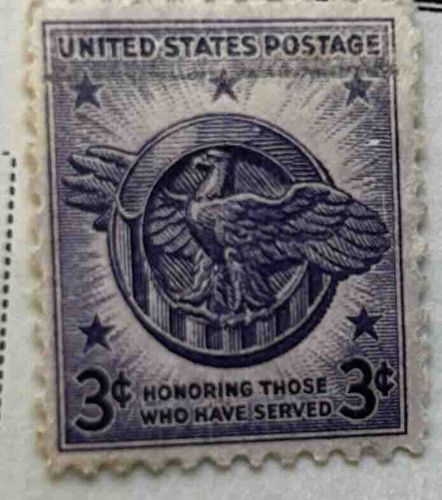
This item is a United States postage stamp, denominated at 3 cents. It features a patriotic design rendered in a monochromatic purple/violet ink on white paper, with a perforated border typical of postage stamps. The central motif is a detailed depiction of a bald eagle, a national symbol of the United States, with its wings spread, set within a circular field. This circular field appears to have vertical stripes as a background pattern and is encircled by a distinct border. Radial lines emanate from behind the central eagle design, suggesting rays of light or glory. Above the main design, the words "UNITED STATES POSTAGE" are printed in block letters. Below the central emblem, the text reads "HONORING THOSE WHO HAVE SERVED" in two lines, acknowledging service members. The denomination "3¢" is prominently displayed in the lower-left and lower-right corners of the stamp, signifying its postal value. Four small five-pointed stars are visible, two above the central motif and two below, adding to the patriotic theme. The stamp exhibits a standard perforation pattern around its edges, which, upon close inspection, appears relatively clean, although some minor fraying or irregularities are visible, particularly on the left side, suggestive of having been separated from a sheet. The overall condition appears good, with clear printing and no immediate signs of significant creasing, tearing, or heavy cancellation. The coloration is consistent, indicating an unblemished ink application. This specific stamp, with its design and denomination, generally dates from the mid-20th century, likely the post-World War II period.
AI Appraisal Report
Based on my visual examination of the provided image, this U.S. 3-cent stamp, commemorating those who have served, appears to be authentic to the design of Scott #936, issued in 1945. The monochromatic purple/violet ink, detailed eagle motif, and text placement align with known examples. Its condition appears good overall, with clear printing and no major creasing or tears evident. The perforations are relatively clean, though minor fraying on the left suggests it was separated from a sheet. I observe no signs of cancellation. Given the item description as 'Chinese stamp,' it is imperative to clarify that this is a United States issue and not a Chinese stamp; this discrepancy must be noted. This stamp was produced in very high quantities, making it a common issue. Market conditions for common post-war U.S. stamps are generally low. Demand is minimal among serious collectors for individual uncancelled examples of this particular stamp due to its abundance; it predominantly appeals to beginner collectors or those filling spaces in basic albums. Rarity is not a factor here. Factors significantly impacting value would be exceptional centering, pristine gum (not verifiable from image), or being part of a rarer plate block or error. Based on current market trends for uncancelled, fine-to-very-fine condition examples of Scott #936, the value is nominal. My assessment of authenticity is limited to visual cues from the image. For full authentication, I would require in-person examination to verify paper type, watermark (if applicable), gum condition, and perforation accuracy. Provenance documentation could also support its history, though for such a common stamp, it's unlikely to impact value significantly.