AI estimate as of October 17, 2025 · verify with a professional before acting
AI-Generated · Verify before acting
Everything on this page is generated by AI for informational purposes only. AI can make mistakes — the AI may misidentify items or misattribute them (artist, maker, brand, designer, origin, era). This is not an official valuation and should not be used for insurance, sale, tax, estate, legal, or lending purposes — or any decision requiring a certified appraisal. It is not an authoritative claim about any person, brand, or rights holder — do not share or rely on it as a factual statement about a third party. Always consult qualified professionals before making financial decisions.
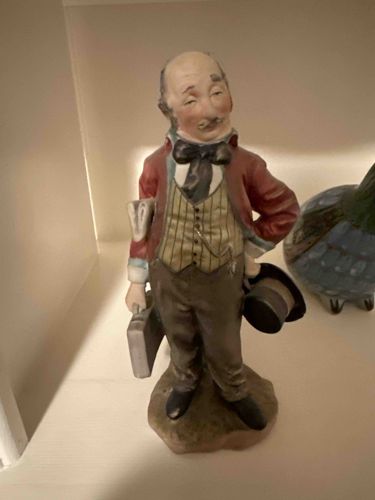
This item is a porcelain figurine depicting a Victorian-era gentleman, likely in a traveling or business context given his attire and accessories. The figure stands upright on a textured, earth-toned base, suggesting a ground surface. He has a bald head with some grey hair visible above his ears, a prominent nose, and a neatly trimmed mustache. His expression appears somewhat content or perhaps slightly weary, with subtly rendered eyes and a small mouth. He is dressed in a red tailcoat, a striped yellow and brown waistcoat, dark trousers, and black shoes. A black cravat or bow tie is visible at his neck. In his left hand, he holds a small, rectangular briefcase or valise, and in his right hand, a dark top hat. The details of his clothing, such as the stripes on the waistcoat and the lapels of the coat, are finely painted. A visible gold chain, possibly a watch chain, runs across his stomach, indicating attention to period detail. The figurine appears to be made of glazed ceramic or porcelain, with a smooth, glossy finish on the attire and skin. There are no obvious signs of significant damage like chips or cracks from the visible angles, but a closer inspection would be needed to confirm overall condition. The colors are rich and distinct, indicating good quality painting. The style suggests a mid-20th-century production, though it emulates an earlier, 19th-century aesthetic. No manufacturer's marks or signatures are visible in the provided image.
AI Appraisal Report
Upon visual examination of this porcelain figurine, I have assessed its condition, style, and potential market value. The subject is a Victorian-era gentleman, well-dressed and accessorized, suggesting a theme of travel or business. The figurine appears to be in very good condition from the images provided, with no visible chips, cracks, or crazing. The colors remain vibrant, and the glaze is intact.
The style, however, suggests a mid-20th-century homage rather than a true 19th-century piece. While it captures the Victorian aesthetic, the production quality, painting style, and glossy finish are more characteristic of Staffordshire-inspired or German-made decorative figures popular post-WWII. The absence of a visible manufacturer's mark is a significant factor. Without a known maker such as Meissen, Royal Doulton, or a specific Staffordshire pottery, the figurine is valued as a decorative item rather than a collectible antique from a renowned maker.
Market comparables for unmarked, mid-century decorative figurines of this nature are modest. Demand is steady but limited to decorators or casual collectors. The value is therefore derived from its decorative appeal. For a definitive appraisal and authentication, a physical examination is essential to identify any underglaze marks, such as a maker's stamp or country of origin, and to assess the piece for any hidden damage or restoration not visible in photographs. A lack of maker identification is the primary factor limiting its value.