AI estimate as of December 5, 2025 · verify with a professional before acting
AI-Generated · Verify before acting
Everything on this page is generated by AI for informational purposes only. AI can make mistakes — the AI may misidentify items or misattribute them (artist, maker, brand, designer, origin, era). This is not an official valuation and should not be used for insurance, sale, tax, estate, legal, or lending purposes — or any decision requiring a certified appraisal. It is not an authoritative claim about any person, brand, or rights holder — do not share or rely on it as a factual statement about a third party. Always consult qualified professionals before making financial decisions.
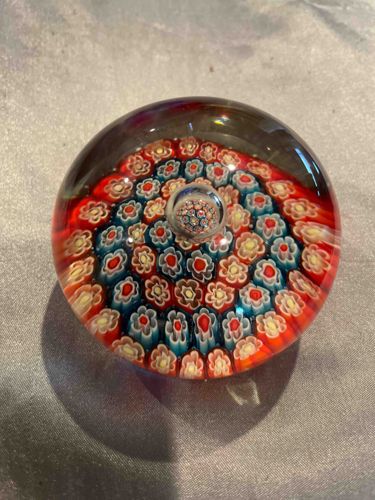
This item is a circular, domed art glass paperweight featuring an intricate millefiori design. The paperweight is crafted from clear glass, encasing a vibrant floral pattern composed of numerous small, multicolored cane sections. The dominant colors in the millefiori canes are bright red, teal blue, and creamy white, with some canes also incorporating brown or a darker outline, creating a three-dimensional effect and depth. The canes are arranged in concentric circles, forming an overall radial pattern that radiates outwards from a central, smaller, intricately detailed millefiori inclusion. This central element appears to be a smaller, self-contained millefiori assembly, adding a layer of complexity and fine craftsmanship. The base of the paperweight appears to be a solid color, possibly red or dark amber, bleeding into the patterned design. The surface of the glass is glossy and reflects light, indicating a smooth, polished finish. No visible chips, cracks, or significant abrasions are immediately apparent from the provided image, suggesting good to excellent condition. The manufacturing process involves fusing multiple glass rods (canes) together and then slicing them to reveal the internal patterns, characteristic of traditional millefiori techniques often associated with Venetian glassworks from the 19th and 20th centuries. The quality of the cane work and the precision of the arrangement are indicators of skilled craftsmanship. The item exhibits a classic art glass aesthetic, likely dating from the mid-20th century or later.
AI Appraisal Report
I have virtually examined this Millefiori Art Glass Paperweight. The item presents in good to excellent condition, displaying a glossy, polished surface with no immediately visible chips, cracks, or significant abrasions. This clean aesthetic significantly enhances its market desirability. Its authenticity as a millefiori art glass piece is evident from the intricate floral pattern, composed of numerous precisely arranged, multicolored cane sections, indicative of this traditional glassmaking technique. The concentric circles, radiating pattern, and particularly the finely detailed central millefiori inclusion, speak to skilled craftsmanship.
Market conditions for millefiori paperweights are generally stable, with a consistent demand among collectors of art glass. While the craftsmanship is apparent, without maker's marks, signatures, or specific design characteristics that tie it to a high-demand artisan or factory (e.g., Baccarat, St. Louis, or specific Venetian masters), it's challenging to ascertain exceptional rarity. Comparables for unsigned, well-executed millefiori paperweights of this stylistic complexity typically fall within the $100-$300 range, depending on size and specific design elements.
Factors significantly impacting value include the excellent apparent condition and the intricate central cane. However, the lack of definitive attribution to a renowned maker limits its potential to reach higher price points. Full authentication and a more precise valuation would benefit greatly from an in-person examination to check for any etched signatures, internal flaws, grinding marks, or material characteristics not discernible from images. Provenance documentation, if available, would also be crucial in verifying its origins and potential maker.