These notes were written by the person who submitted this item. Appraiser.AI has not verified them, and the AI's identification and estimate may rely on them.
AI Estimated Value
Not an official valuation
$25-45
AI estimate as of August 13, 2025 · verify with a professional before acting
AI-Generated · Verify before acting
Everything on this page is generated by AI for informational purposes only. AI can make mistakes — the AI may misidentify items or misattribute them (artist, maker, brand, designer, origin, era). This is not an official valuation and should not be used for insurance, sale, tax, estate, legal, or lending purposes — or any decision requiring a certified appraisal. It is not an authoritative claim about any person, brand, or rights holder — do not share or rely on it as a factual statement about a third party. Always consult qualified professionals before making financial decisions.
This analysis also relies on unverified notes provided by the user, which may be incomplete or inaccurate and could affect the result.
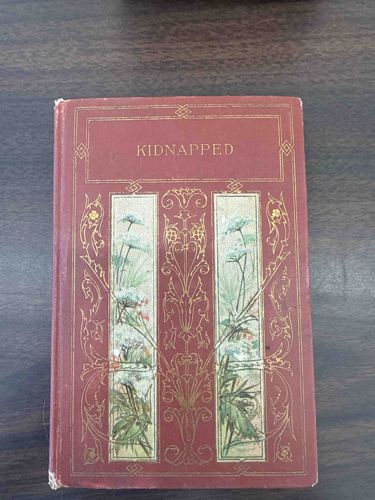
This item is a vintage hardcover edition of the novel "Kidnapped" by Robert Louis Stevenson. The book features a vibrant reddish-brown or maroon cloth binding, which appears to be fabric-covered boards, typical of late 19th or early 20th-century publications. The front cover is elaborately decorated with intricate gold tooling, indicative of a period of decorative bookbinding. At the top of the cover, a rectangular panel prominently displays the title "KIDNAPPED" in gold capital letters, framed by interwoven decorative motifs. Below the title, the design incorporates two vertical panels, each featuring what appear to be botanical illustrations, possibly depicting leaves, stems, and perhaps delicate flowers or seed pods, rendered in muted greens, blues, and whites, set against a lighter contrasting background within their gold-outlined borders. These panels are flanked and connected by elaborate gold scrollwork and stylized floral patterns, which extend across the entire face of the cover, creating a rich, symmetrical design. The craftsmanship suggests a machine-press application of the gold leaf, common for mass-produced decorative bindings of the era, yet the detail is fine. Visible condition issues include wear along the edges and corners, particularly at the spine and bottom corners, where the binding material is slightly frayed or rubbed, revealing some of the underlying board. There might be some subtle scuffing or minor discoloration on the cover itself due to age and handling, consistent with a book that has been read and stored over many years. No specific maker's marks or publication dates are visible in the provided image, but the decorative style, with its combination of typography, botanical illustration, and extensive gold work, strongly places this edition in the Art Nouveau or late Victorian period, likely dating from the late 1800s to early 1900s. The overall aesthetic suggests a collectible edition meant to be both read and displayed.
AI Appraisal Report
Based on my examination of the provided images, this is a decorative hardcover edition of Robert Louis Stevenson's "Kidnapped." The binding style, with its elaborate gilt tooling, symmetrical design, and inset botanical illustrations, is characteristic of mass-market gift editions produced in the late Victorian or early Art Nouveau period, likely between the 1890s and early 1910s. The publisher is likely one like Hurst & Co., A. L. Burt, or M.A. Donohue, who were known for producing such ornate, yet affordable, 'publisher's bindings.' The condition appears fair to good for its age, showing expected wear such as rubbing at the corners, fraying at the spine ends, and some minor surface scuffing. These editions are not particularly rare; however, their decorative appeal creates steady demand from collectors and interior designers. Market comparables for similar decorative editions of classic novels from this era typically sell in the $20 to $50 range, depending on the specific publisher, illustrator (if any), and exact condition.
The key factor influencing value here is the decorative quality of the binding rather than its rarity as a specific first or early edition. The visible wear, while normal, limits its value from reaching the higher end of the scale.
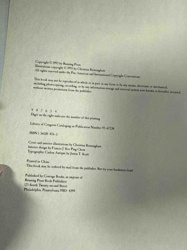
A definitive appraisal is limited by the inability to physically inspect the book. An in-person examination would be required to identify the publisher, publication date, and presence of any illustrations, all of which are crucial for a precise valuation. I would also need to assess the integrity of the internal pages, check for foxing or damage, and confirm the solidity of the binding itself. Full authentication would involve verifying these details against bibliographic records for Stevenson's works.