These notes were written by the person who submitted this item. Appraiser.AI has not verified them, and the AI's identification and estimate may rely on them.
AI Estimated Value
Not an official valuation
$40 - $70
AI estimate as of August 30, 2025 · verify with a professional before acting
AI-Generated · Verify before acting
Everything on this page is generated by AI for informational purposes only. AI can make mistakes — the AI may misidentify items or misattribute them (artist, maker, brand, designer, origin, era). This is not an official valuation and should not be used for insurance, sale, tax, estate, legal, or lending purposes — or any decision requiring a certified appraisal. It is not an authoritative claim about any person, brand, or rights holder — do not share or rely on it as a factual statement about a third party. Always consult qualified professionals before making financial decisions.
This analysis also relies on unverified notes provided by the user, which may be incomplete or inaccurate and could affect the result.
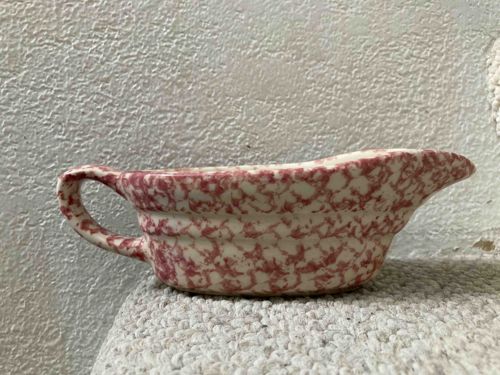
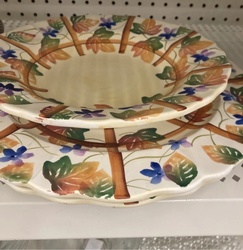
This item is a ceramic gravy boat, distinguished by its unique spatterware or spongeware decoration. The primary body of the boat is an off-white or cream color, serving as a base for the irregular, mottled patterns of deep pink or maroon. This spatterware effect is consistent across the exterior of the vessel, including the handle and the pouring spout, suggesting a deliberate and uniform application technique. The gravy boat features a classic, elongated oval shape with a gently flaring rim. One end terminates in a well-defined pouring spout, designed for controlled dispensing of liquids, while the opposite end has a sturdy, C-shaped handle, providing a comfortable grip. The rim of the boat appears to have a slightly scalloped or uneven edge, adding to its rustic charm. The material is clearly ceramic, likely earthenware or stoneware, given its opaque appearance and the visible texture of the glaze, which seems somewhat imperfect or handmade, contributing to its folk art appeal. There are no visible chips, cracks, or significant damage, and the glaze appears largely intact, showing minimal signs of wear or crazing, which would suggest a good condition for its age. The item's aesthetic suggests a mid-20th century or earlier production, characteristic of utilitarian farmhouse or country kitchen wares from the United States or Europe. The craftsmanship points to a mass-produced but still individually decorated piece, with small variations in the spatter pattern being evidence of this. No maker's marks or signatures are discernible from the provided images, which is common for such utility ware. This piece embodies a durable and decorative style suitable for everyday use or as a collector's item within the realm of vintage pottery.
AI Appraisal Report
Upon examining the provided image of this spatterware ceramic gravy boat, I can provide an appraisal based on its visual characteristics and the owner's description. The item presents as a classic example of spongeware or spatterware, a popular decorative technique for utilitarian ceramics. The off-white body with deep pink/maroon spattering across the entire exterior, including the handle and spout, indicates a consistent application. Its elongated oval shape with a flaring rim and C-shaped handle is typical of gravy boats from the mid-20th century or earlier. The description of a slightly scalloped rim adds to its charm, aligning with a folk art or rustic aesthetic.
From the image, the condition appears excellent. There are no visible chips, cracks, or significant damage, and the glaze seems largely intact, suggesting minimal wear. This good condition is a positive factor for its value. Spatterware ceramic gravy dishes are generally quite common, and while collectible, they don't typically command high prices unless they are from a highly sought-after manufacturer or have a particularly rare pattern. The lack of discernible maker's marks is common for this type of utility ware and limits the potential for a higher-end valuation.
Demand for such vintage tableware remains steady among collectors of primitive, farmhouse, or country kitchen decor. However, it's not a rare item. Factors impacting value include its appealing condition and classic design. Limitations in authenticity verification from images alone include the inability to confirm the true material (earthenware vs. stoneware), assess glaze crazing or hairline cracks not visible in photos, or detect professional repairs. A hands-on physical inspection would be needed to confirm the ceramic body, assess the exact weight and feel, and meticulously check for any hidden imperfections. Provenance documentation would also confirm its age and origin. Based on its visual appeal and condition, I would place its current market value in the range of $40 to $70.