These notes were written by the person who submitted this item. Appraiser.AI has not verified them, and the AI's identification and estimate may rely on them.
AI Estimated Value
Not an official valuation
$600-1,200
AI estimate as of July 7, 2025 · verify with a professional before acting
AI-Generated · Verify before acting
Everything on this page is generated by AI for informational purposes only. AI can make mistakes — the AI may misidentify items or misattribute them (artist, maker, brand, designer, origin, era). This is not an official valuation and should not be used for insurance, sale, tax, estate, legal, or lending purposes — or any decision requiring a certified appraisal. It is not an authoritative claim about any person, brand, or rights holder — do not share or rely on it as a factual statement about a third party. Always consult qualified professionals before making financial decisions.
This analysis also relies on unverified notes provided by the user, which may be incomplete or inaccurate and could affect the result.
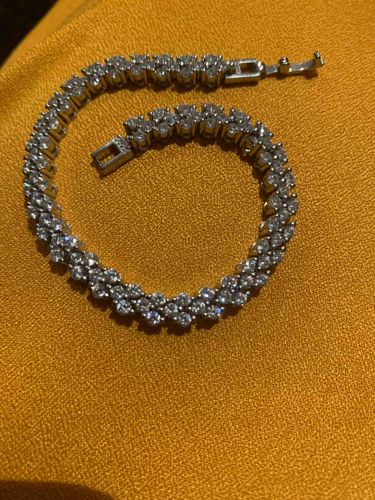
This item is a dazzling tennis bracelet, likely crafted from a white metal such as sterling silver, white gold, or platinum, given its bright, reflective surface. The bracelet features a continuous linear arrangement of numerous round brilliant cut stones, which, given the 'Moissante' context, are almost certainly moissanite. Each individual stone appears to be securely held in a four-prong setting, ensuring maximum light exposure for brilliance. The settings are designed in a linked fashion, allowing the bracelet to articulate fluidly around the wrist. The stones are uniform in size, forming a graceful, unbroken line of sparkle. The clasp mechanism appears to be a box clasp with a safety catch, characteristic of quality bracelets to prevent accidental opening. No significant wear or damage is overtly visible from the provided images, suggesting it is in good to excellent condition. The craftsmanship appears to be precise, with well-formed prongs and consistent stone placement, indicative of a moderately to high-quality piece. The bracelet's design is classic and timeless, often associated with a contemporary style period. The overall aesthetic is one of elegant simplicity, emphasizing the continuous sparkle of the stones. The piece does not show overt signs of age, such as heavy patina or significant scratches, suggesting it could be relatively new or very well-maintained.
AI Appraisal Report
Based on my visual examination of the Moissanite tennis bracelet, the condition appears to be excellent, showing no significant wear, damage, or overt signs of age. The craftsmanship, with its precise four-prong settings and consistent stone placement, suggests a moderately to high-quality piece. The continuous linear arrangement of uniform round brilliant cut stones, set in what appears to be a white metal, aligns perfectly with the classic tennis bracelet design.
Authenticity of the stones as moissanite, however, cannot be definitively confirmed from images alone. While the brilliance and fire are consistent with moissanite, these visual cues can also be present in other diamond simulants or even lower-grade diamonds. Similarly, the specific white metal (sterling silver, white gold, or platinum) cannot be determined without physical testing.
Market conditions for moissanite tennis bracelets are robust, driven by their affordability and ethical sourcing compared to natural diamond counterparts, while offering comparable brilliance. Comparables in the market for new moissanite tennis bracelets of this apparent quality and size typically range based on the total carat weight equivalent and the metal type. Demand for such classic and versatile pieces remains consistently high. Factors significantly impacting value include the total carat weight equivalent, the specific metal (platinum being highest, followed by white gold, then sterling silver), and the cut quality of the moissanite.
To provide a full and accurate appraisal, an in-person examination is crucial. This would allow for: 1) Diamond or Moissanite tester to confirm the identity of the stones. 2) Specific gravity, scratch, or XRF testing to identify the precise metal composition. 3) Measurement of individual stones to estimate total carat weight equivalent. 4) Verification of the clasp's security and overall structural integrity. Without these physical assessments, the appraisal value remains an estimate based on visual and market assumptions.