AI estimate as of October 17, 2025 · verify with a professional before acting
AI-Generated · Verify before acting
Everything on this page is generated by AI for informational purposes only. AI can make mistakes — the AI may misidentify items or misattribute them (artist, maker, brand, designer, origin, era). This is not an official valuation and should not be used for insurance, sale, tax, estate, legal, or lending purposes — or any decision requiring a certified appraisal. It is not an authoritative claim about any person, brand, or rights holder — do not share or rely on it as a factual statement about a third party. Always consult qualified professionals before making financial decisions.
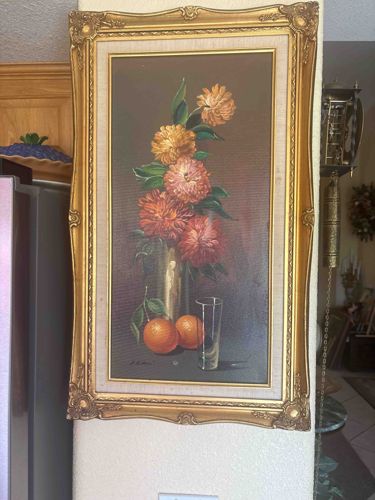
This item is an oil painting depicting a still life composition, framed in a substantial, ornate gilded frame. The central subject of the painting features a bouquet of chrysanthemum-like flowers in shades of orange, peach, and coral, arranged in a tall, slender brass or gold-toned vase. The flowers exhibit intricate petal details and are accompanied by green foliage. To the lower left of the vase, two ripe oranges with green leaves and a stem are depicted, alongside a clear, empty drinking glass with a cylindrical shape, reflecting some light on its surface. The background of the painting is a dark, muted brown or olive tone, providing a stark contrast to the vibrant colors of the foreground elements. The painting technique appears to involve visible brushstrokes, suggesting an oil medium, possibly on canvas. A signature is visible in the lower left corner, though it is not clearly legible from the provided image. The frame itself is wide and elaborate, constructed of wood or a similar composite material, finished with an aged gold leaf or paint. It features classical-inspired ornamentation, including acanthus leaf motifs and a pronounced beveled profile, contributing to a regal aesthetic. The inner edge of the frame has a narrow, light-colored (possibly off-white or cream) linen or painted liner, separating the artwork from the ornate gold. The overall condition appears good, with no obvious signs of significant damage, tears in the canvas, or major chips to the frame, though minor wear consistent with age and handling would be expected. The style suggests a mid-20th-century impressionistic or realist approach to still life, possibly created between the 1950s and 1980s, reflecting a traditional decorative art piece.
AI Appraisal Report
I have examined the provided image of this still life oil painting. The artwork depicts chrysanthemums and oranges, framed in a substantial gilded frame. The composition is traditional, with vibrant colors in the foreground contrasting against a dark background, typical of a mid-20th-century decorative style (1950s-1980s). Visible brushstrokes suggest an oil medium, likely on canvas. The overall condition appears good, with no obvious signs of significant damage to the canvas or the ornate frame from the visual assessment. Minor wear consistent with age is expected for such an item.
Market conditions for traditional decorative still life paintings by unknown artists are generally moderate. While the painting is aesthetically pleasing and well-executed for its genre, the lack of a clearly legible signature and verifiable artist provenance significantly impacts its value. Comparables in this category typically sell in the low to mid-hundreds at auction or retail, primarily driven by aesthetic appeal and decorative suitability rather than artistic merit or investment potential. Demand for such pieces is steady among buyers looking for traditional home decor, but rarity is not a factor here.
Several factors limit a definitive appraisal without physical inspection. The legibility of the signature is crucial for artist identification; an in-person examination could reveal the artist, potentially increasing value if it's a recognized name. Authenticity of the medium (oil on canvas vs. print/giclée with texture) and dating would require direct inspection. Provenance documentation, if available, would be vital for any claim of significant artistic importance. Without these, it remains a decorative piece by an unidentified artist.