AI estimate as of November 20, 2025 · verify with a professional before acting
AI-Generated · Verify before acting
Everything on this page is generated by AI for informational purposes only. AI can make mistakes — the AI may misidentify items or misattribute them (artist, maker, brand, designer, origin, era). This is not an official valuation and should not be used for insurance, sale, tax, estate, legal, or lending purposes — or any decision requiring a certified appraisal. It is not an authoritative claim about any person, brand, or rights holder — do not share or rely on it as a factual statement about a third party. Always consult qualified professionals before making financial decisions.
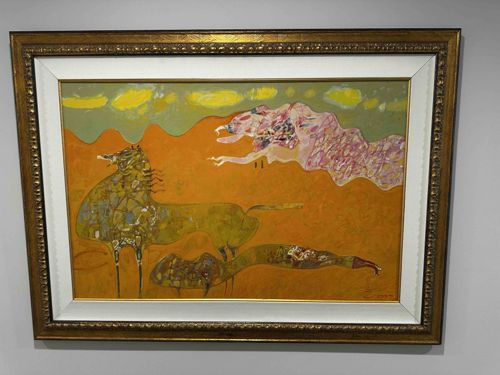
This is an abstract figurative painting depicting what appear to be stylized horses and a human-like figure in motion. The color palette predominantly features warm earthy tones, with a large expanse of vibrant orange creating a dynamic ground or landscape, topped by a muted olive green suggesting a distant horizon or sky, punctuated by irregular yellow cloud-like forms. The main subject, a horse-like creature, occupies the left and central foreground, rendered in mottled greens, golds, and browns, with intricate, almost geometric patterns within its form, suggesting a mosaic or fragmented texture. It appears to be standing on attenuated legs. Below it, another, more elongated and prone animal form in similar colors enhances the sense of a surreal landscape. Floating above these figures on the right is a swirling, pink and white form, suggestive of a running or dancing human figure, possibly draped in fabric, with expressive, fluid lines. The background offers a soft-edged, wavy separation between the orange and green sections, adding to the dreamlike quality. The brushwork throughout is expressive and textural, with visible impasto in areas, particularly in the pink figure and the patterned animals. The painting is housed within a substantial frame comprising an inner white or off-white liner and an outer ornate gold-toned frame with a visible relief pattern, possibly carved or molded, indicating a decorative aesthetic. No obvious damage or significant wear is visible on the painting itself from the provided image; however, the frame shows some minor scuffing or patina consistent with age and handling. The style suggests a mid-20th century to late-20th century aesthetic, leaning towards modern abstraction with surrealist undertones. A potential signature is faintly visible in the lower right corner but is not legible. The craftsmanship appears good, with a deliberate compositional balance and engaging use of color and texture.
AI Appraisal Report
Based on my visual examination of the provided image of this Abstract Figurative Painting (Horses and Figure), I assess its condition to be good. The colors remain vibrant, and there are no immediately discernible signs of paint loss, cracks, or significant abrasions on the canvas itself. The visible impasto and expressive brushwork appear intentional. The ornate gold-toned frame, while substantial and aesthetically pleasing, shows some minor scuffing or patina, which is consistent with its age and handling and does not detract significantly from the overall presentation. The style strongly suggests a mid to late 20th-century aesthetic, possibly leaning towards modern abstraction with surrealist or mythological undertones.
Market conditions for unsigned abstract figurative works vary widely. While the artistic merit, compositional balance, and engaging use of color and texture are evident, the lack of a clearly legible signature and definitive attribution impacts its market value. Comparable works by lesser-known or anonymous artists in this style typically command prices in the mid-hundreds to low thousands. Demand for such pieces is moderate, appealing to collectors who appreciate expressive, decorative art with a unique narrative quality.
Factors significantly impacting this value include its unsigned status and the challenge of authenticating the artist without further information. The craftsmanship appears good, indicating a trained hand, but without a name, it's difficult to gauge rarity. For full authentication and a more precise valuation, an in-person examination would be crucial to assess the true texture, medium, and finer details of the brushwork. Provenance documentation, such as exhibition history or previous ownership records, would be invaluable. Furthermore, scientific testing could potentially confirm dating or materials used, aiding in attribution. Without these, any authenticity claim remains speculative solely based on visual evidence.