AI estimate as of July 31, 2025 · verify with a professional before acting
AI-Generated · Verify before acting
Everything on this page is generated by AI for informational purposes only. AI can make mistakes — the AI may misidentify items or misattribute them (artist, maker, brand, designer, origin, era). This is not an official valuation and should not be used for insurance, sale, tax, estate, legal, or lending purposes — or any decision requiring a certified appraisal. It is not an authoritative claim about any person, brand, or rights holder — do not share or rely on it as a factual statement about a third party. Always consult qualified professionals before making financial decisions.
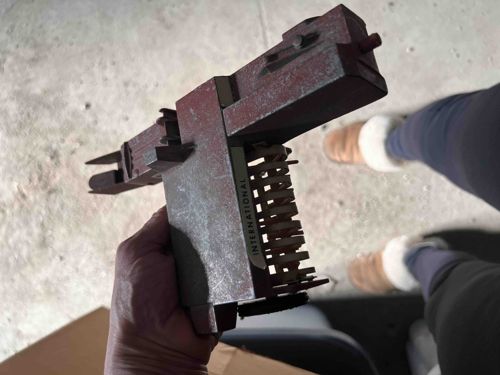
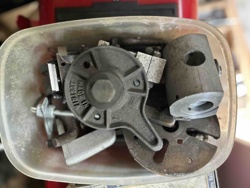
This appears to be a vintage industrial electrical component, likely a multi-pin connector or a terminal block assembly, possibly a relay or control module given its overall construction. The item is predominantly made of a dark, likely bakelite or similar thermosetting plastic, which has a reddish-brown hue and a matte finish. There are visible signs of age and wear, including surface scratches, scuffs, and a general loss of original luster, suggesting a working life in an industrial setting. The piece is box-shaped with various protrusions and connectors. On one side, there is a prominent bank of numerous metallic pins or terminals, arranged in a staggered or stepped configuration. These pins exhibit some oxidation and a dull metallic patina. A notable feature is the embossed or stamped text "INTERNATIONAL" visible on the vertical face of the unit, indicating the manufacturer or product line. Another section of the item has several 'fingers' or prongs, suggesting it might interface with another component. The construction appears robust and utilitarian, designed for functionality rather than aesthetics, characteristic of industrial equipment. There are no obvious signs of major repair or significant damage, though the surface wear is consistent with considerable use. The age is estimated to be mid-20th century, perhaps 1940s-1960s, based on the material, construction, and style of the lettering. Its craftsmanship indicates a manufactured, mass-produced item of its time, built to endure harsh industrial conditions. The quality is functional and durable.
AI Appraisal Report
Upon examining the provided image, this Vintage International Industrial Electrical Connector / Terminal Block appears to be authentic to the mid-20th century (1940s-1960s), consistent with the 'INTERNATIONAL' embossing, bakelite-like material, and robust, utilitarian design. The reddish-brown thermoset plastic, common for that era, shows significant surface wear, including scratches, scuffs, and a dull patina, indicative of prolonged use in an industrial environment. The metallic pins exhibit oxidation. This condition is typical for an object of this age and intended purpose; it is well-preserved given its working history, with no obvious major damage or repairs visible.
Limitations in authenticity verification exist as I can only assess visual cues. A full authentication would require in-person examination to verify material composition, confirm the manufacturing process (e.g., molding marks, internal components), and detect any subtle repairs not visible in imagery. Provenance documentation, such as original schematics or purchase records, would further solidify its history. Scientific testing, like material analysis, could definitively confirm its composition and age.
Regarding market conditions, industrial electrical components from this era generally attract niche collectors, hobbyists restoring vintage machinery, or those specifically looking for period-correct parts. Comparables for such specific components are limited but typically fall into the "parts" category rather than highly sought-after collectibles unless tied to a significant historical machine or event. Demand is low to moderate, driven by specific project needs. Rarity is difficult to assess without knowing production numbers, but such industrial pieces are not commonly found in the general antiques market. The primary value drivers are its functional integrity, which cannot be tested here, and its originality. The 'INTERNATIONAL' branding adds a minor collectible appeal. Given its visible wear and tear, and assuming it is non-functional or its functionality is unverified, its value is mainly as a historical artifact or replacement part.