AI estimate as of November 15, 2025 · verify with a professional before acting
AI-Generated · Verify before acting
Everything on this page is generated by AI for informational purposes only. AI can make mistakes — the AI may misidentify items or misattribute them (artist, maker, brand, designer, origin, era). This is not an official valuation and should not be used for insurance, sale, tax, estate, legal, or lending purposes — or any decision requiring a certified appraisal. It is not an authoritative claim about any person, brand, or rights holder — do not share or rely on it as a factual statement about a third party. Always consult qualified professionals before making financial decisions.
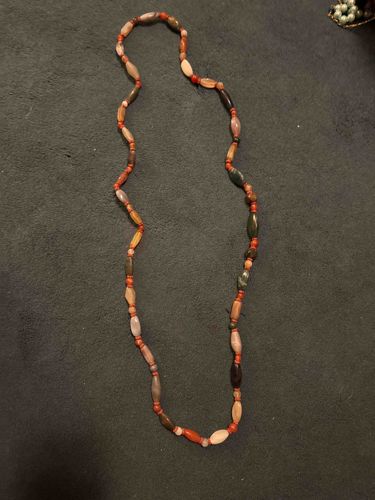
This is a single strand necklace featuring a combination of natural stone beads and smaller, possibly seed or coral beads, creating a continuous loop. The primary beads are elongated and somewhat irregularly shaped, varying in size and exhibiting a diverse palette of earthy tones including shades of cream, beige, light pink, dark brown, green, and various mottled or striped patterns. These larger beads are separated by smaller, rounder, reddish-orange beads, consistent in color and shape, suggesting they might be coral or dyed seed beads. The stringing material is not visible, implying it's either durable thread or wire, securely holding the beads together. The overall length of the necklace appears substantial, designed to hang loosely or be doubled. There are no visible clasps or closures, indicating it's likely a continuous loop necklace that can be slipped over the head. The condition appears good, with no obvious signs of significant damage, broken beads, or fraying. The stones seem to have a smooth, polished finish. The combination of natural stone and vibrant red accents gives it a rustic yet artistic appeal, possibly handmade or a piece of artisan jewelry. The style suggests a bohemian or ethnic influence, popular across various contemporary and vintage periods. The craftsmanship appears to be of good quality, with consistent bead spacing and well-drilled holes in the beads.
AI Appraisal Report
This Multi-Colored Stone and Seed Bead Necklace presents a visually appealing combination of natural stones and smaller seed or coral beads. Based on my visual examination, the condition appears good; the beads show no obvious chips or damage, and the stringing seems intact, suggesting good craftsmanship. The smooth, polished finish of the stones is well-maintained. The absence of a clasp indicates a continuous loop design, likely intended to be slipped over the head.
Authenticity of the larger stones as natural and the smaller beads as coral (or a suitable substitute) cannot be definitively confirmed from images alone. An in-person examination would be necessary to assess bead material, weight, and internal characteristics to confirm their natural origin versus synthetic or treated materials. Similarly, distinguishing between seed beads and genuine coral without tactile inspection or advanced testing is difficult.
In terms of market conditions, this style, with its bohemian and earthy aesthetic, generally appeals to a niche market. Comparable items in artisan or handmade jewelry categories, especially those featuring actual semi-precious stones, typically retail in the $75-$150 range for well-made pieces. Demand is moderate, driven by personal style preferences rather than investment value. Rarity is not a significant factor here; similar designs using various natural stones are common.
Key factors impacting value include the actual composition of the stones and smaller beads (whether they are indeed natural semi-precious stones and genuine coral/high-quality seed beads), the quality of the stringing material used (not visible), and the overall craftsmanship. If the stones are genuine and the smaller beads are good quality, the piece holds modest value. Without provenance documentation or a physical inspection by a gemologist, confirming material authenticity for a more precise valuation is limited. We assume, based on visual cues, that the materials are as depicted in the description. Scientific testing would be necessary to confirm the exact nature of the materials.