AI estimate as of July 22, 2025 · verify with a professional before acting
AI-Generated · Verify before acting
Everything on this page is generated by AI for informational purposes only. AI can make mistakes — the AI may misidentify items or misattribute them (artist, maker, brand, designer, origin, era). This is not an official valuation and should not be used for insurance, sale, tax, estate, legal, or lending purposes — or any decision requiring a certified appraisal. It is not an authoritative claim about any person, brand, or rights holder — do not share or rely on it as a factual statement about a third party. Always consult qualified professionals before making financial decisions.
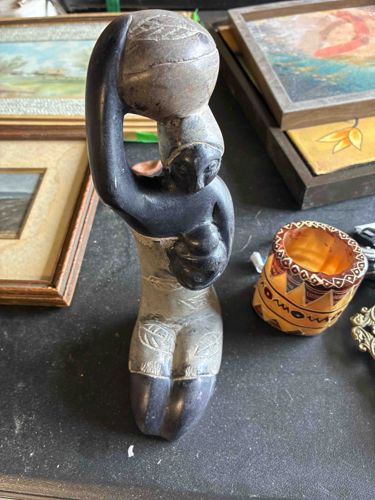
This item is a hand-carved stone sculpture depicting an African woman carrying a round object, possibly a water pot or basket, on her head, while also carrying a child on her back. The sculpture is made from what appears to be a type of soapstone or similar soft stone, exhibiting two distinct colorations: a darker, almost black, polished finish for the upper body, arms, and lower legs/feet, and a lighter, grayish-tan, matte finish for the central body (torso and upper legs) and headpiece/pot. The contrast in finishes highlights different elements of the figure's attire and skin tone. The figure stands upright, with one arm raised to support the object on her head. The facial features are subtly rendered, with a clear depiction of the head covering. The lighter-colored sections, particularly the skirt-like area around her hips and upper thighs, are adorned with incised decorative patterns, including stylized leaf motifs. The overall construction suggests a solid, single-piece carving. While the material shows some natural variations and slight imperfections inherent to stone, there are no immediately visible chips, cracks, or significant damage. The surface has a slight dusty patina, indicating age or lack of recent cleaning. The craftsmanship suggests a folk art or tribal art style, likely from an African region, focusing on everyday life scenes. The piece exhibits a raw, yet expressive quality, indicative of hand-carved work rather than mass production. Its estimated age is difficult to pinpoint without further context, but it aligns with tourist art or local artisanal production from the mid-to-late 20th century.
AI Appraisal Report
Upon visual examination of the provided image, this hand-carved stone sculpture depicts an African woman with a child and a head-borne object. The material appears to be a type of soapstone, characterized by two distinct finishes: a darker polished section for extremities and a lighter, matte finish for the torso and headpiece. The incised decorative patterns on the lighter areas suggest careful craftsmanship. Its condition appears stable, with no visible chips, cracks, or significant damage, though a slight dusty patina indicates age. This piece exhibits characteristics of African folk or tribal art, likely intended for the tourist market or local artisanal production.
Authenticity: While it presents as a genuine hand-carved piece, verifying its precise origin and age is challenging from images alone. I suspect it falls into the mid-to-late 20th century production. A physical examination would allow for closer inspection of tool marks, material density, and any hidden repairs. Provenance documentation, such as point of acquisition or artist information, would greatly aid in full authentication.
Market Conditions & Comparables: The market for such 'folk art' or 'tourist art' pieces varies. While unique, they are not exceedingly rare. Similar carvings in soapstone or soft stone from various African regions frequently appear in online auctions, ethnic art galleries, and antique shops. Pieces of this scale and aesthetic typically fetch modest prices unless attributed to a known artist or possessing significant historical provenance. The craftsmanship is competent and appealing.
Demand & Rarity: Demand for this specific style is niche but consistent among collectors of world art and ethnic decor. It is not rare in the broader sense of African art but stands out from mass-produced items due to its clear hand-carved nature.
Factors Impacting Value: The two-tone finish and detailed incised patterns enhance its aesthetic appeal. Its condition as depicted is good. Lack of definitive artist attribution or specific tribal origin limits its upper value potential. It is generally representative of a decorative art piece rather than a major collectible.
Limitations: My assessment is based solely on visual interpretation of the image provided. A hands-on examination would be crucial for definitive material identification, assessment of weight, and detection of subtle imperfections or repairs. Chemical analysis of the stone could confirm its composition. Without provenance or direct artist linkage, the value remains in the decorative art category rather than fine art.