AI Appraisal Estimate

AI-generated estimates · not official valuations

From the user

What was submitted

Photo and notes provided by the user — not generated by AI

Submitted item photo
Submitted photo · May 25, 2026

User's notes

No additional notes provided.

AI analysis below

AI appraisal

AI analysis & estimate

AI-Generated · Verify before acting

Everything below is generated by AI for informational purposes only. AI can make mistakes — the AI may misidentify items or misattribute them (artist, maker, brand, designer, origin, era). This is not an official valuation and should not be used for insurance, sale, tax, estate, legal, or lending purposes — or any decision requiring a certified appraisal. It is not an authoritative claim about any person, brand, or rights holder — do not share or rely on it as a factual statement about a third party. Always consult qualified professionals before making financial decisions.

Read the full disclaimer

AI Identification

·Not independently authenticated·Verify before acting

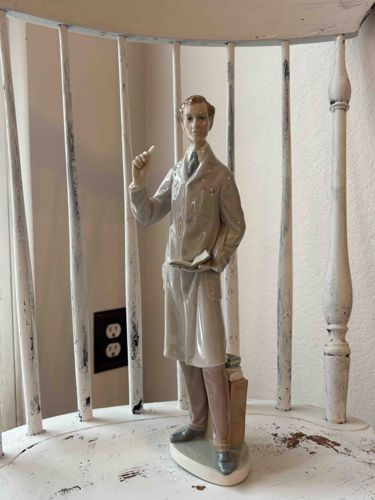
Lladró Porcelain Figurine "The Apothecary" (Model #1204)

Collectible Porcelain Stautary

AI Estimated Value

·Not an official valuation·Verify before acting

$450.00 - $600.00

As of May 25, 2026

AI Item Analysis

·AI can make mistakes·Verify before acting
This is a vintage fine porcelain figurine produced by the renowned Spanish manufacture Lladró, specifically the model known as 'The Apothecary' (El Farmacéutico), sculpted by Salvador Furió. The piece stands approximately 12.5 inches (32 cm) tall and is crafted with high-glaze porcelain in a muted, sophisticated palette of soft greys, taupes, and subtle browns typical of 1970s and 1980s Lladró styling. The figure depicts a professional male figure, likely a pharmacist or chemist, standing in a lab coat over trousers and a tie. He holds an open book in his left hand and a glass vial or test tube in his raised right hand, gesturing as if in contemplation or instruction. Behind his legs sits a stack of books and laboratory vessels upon an oval integrated base. The craftsmanship displays the characteristically elongated, slender limbs and expressive, delicate facial features that define the Lladró aesthetic. The glaze appears uniform and reflective, indicating high-quality firing. Upon inspection, the piece appears to be in excellent condition with no visible cracks, chips, or professional repairs. The tips of the fingers and the fragile vial remain intact, which are common failure points for this model. Although the underside is not visible, this model typically bears the 'Lladró Hand Made in Spain' blue tulip backstamp and incised model numbers, dating its production between its introduction in 1972 and its retirement in 1991.
AI Appraisal Report

·AI can make mistakes·Verify before acting
I have conducted a detailed visual examination of the Lladró porcelain figurine 'The Apothecary' (Model #1204), designed by Salvador Furió. Upon inspection, the piece appears to be in excellent 'near-mint' condition. This particular model is susceptible to damage in the extended fingers and the glass vial; however, these extremities appear intact. The high-glaze finish is consistent with Lladró’s production standards from the 1970s and 80s, displaying no visible crazing or surface wear. Authenticity is supported by the specific muted color palette and the characteristic elongated proportions associated with Furió’s work. The current secondary market for retired Lladró pieces remains stable, though price points are lower than their 1990s peak. 'The Apothecary' is a desirable retired piece (retired in 1991), particularly within the 'professional occupations' collector niche. Comparable sales in recent auctions for well-maintained examples of this model typically fall between $450 and $600. The presence of the original box and documentation would provide a 10-15% premium, though they are not present here. Limitations: This appraisal is based solely on high-resolution imagery. A definitive authentication requires a physical inspection of the underside to confirm the blue 'Tulip' backstamp and incised date codes. Furthermore, tactile examination is necessary to ensure no professional restorations (such as 'cold painting' or resin bonding on the fingers) have been performed, as such repairs can decrease value by over 50%. A black-light test would be the recommended scientific method during an in-person session to reveal hidden adhesives or overpaints.

Get your items appraised

Instant estimates of your treasures with AI-powered appraisals

Browse More Appraisals