These notes were written by the person who submitted this item. Appraiser.AI has not verified them, and the AI's identification and estimate may rely on them.
AI Estimated Value
Not an official valuation
$45-65
AI estimate as of October 10, 2025 · verify with a professional before acting
AI-Generated · Verify before acting
Everything on this page is generated by AI for informational purposes only. AI can make mistakes — the AI may misidentify items or misattribute them (artist, maker, brand, designer, origin, era). This is not an official valuation and should not be used for insurance, sale, tax, estate, legal, or lending purposes — or any decision requiring a certified appraisal. It is not an authoritative claim about any person, brand, or rights holder — do not share or rely on it as a factual statement about a third party. Always consult qualified professionals before making financial decisions.
This analysis also relies on unverified notes provided by the user, which may be incomplete or inaccurate and could affect the result.
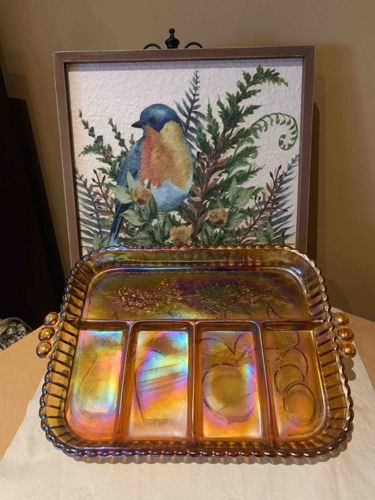
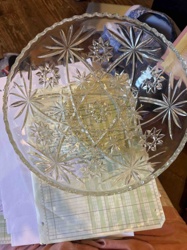
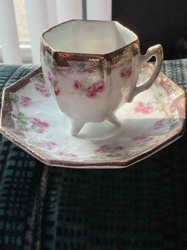
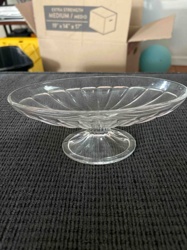
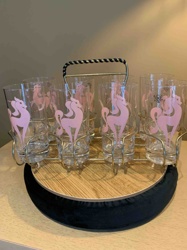
This item is a beautiful vintage carnival glass tray, exhibiting a rich, iridescent amber or marigold color with a striking rainbow-like sheen that shifts with the light. The tray is rectangular with rounded corners and features a scalloped or fluted edge detail along its entire perimeter, adding to its decorative appeal. It is designed as a divided serving piece, with multiple compartments. The main, larger upper section is ideal for displaying a centerpiece or larger food items, and is embossed with a detailed pattern reminiscent of berries and foliage. Below this, there are four smaller, distinct compartments, each with a unique embossed fruit design. From left to right, these appear to be a pear, an apple, and two designs that could represent citrus slices or other round fruits. The entire surface, both interior and exterior, showcases the characteristic iridescence of carnival glass. On either short side, outside the main serving area, there are small, rounded handles or decorative elements composed of three stacked, spherical glass beads. The construction appears to be molded glass, typical of carnival glass manufacturing. The condition appears to be good with no obvious chips, cracks, or significant wear visible from the photograph, although the inherent nature of carnival glass often includes minor manufacturing imperfections such as mold lines or bubbles. This style of glass was particularly popular from the early 20th century, suggesting an estimated age from the 1900s to the 1940s. The quality indicates standard mass-produced decorative and functional glassware of the period.
AI Appraisal Report
Upon visual examination of the provided images, I have assessed this vintage carnival glass divided serving tray. The piece presents as a classic example of mass-produced American glassware, likely dating from the 1920s to the 1940s. The amber or marigold coloration with its characteristic iridescent sheen, combined with the embossed fruit and berry motifs, is typical for this era. Specifically, this pattern is widely recognized as the "Fruits and Flowers" pattern, a common but beloved design. My assessment of the condition, based on the images, is good to very good, with no apparent chips, cracks, or significant scratches that would detract from its value. The scalloped edges and beaded handles appear intact.
Market analysis shows that while carnival glass has a dedicated collector base, this particular pattern and form is quite common. Comparable sales for similar "Fruits and Flowers" marigold divided trays on online auction sites and at antique dealers consistently fall within a modest range. The primary value driver for this piece is its decorative appeal and good condition rather than rarity. Demand is steady but not high, as the market is well-supplied with similar examples.
It is crucial to note the limitations of an appraisal based solely on images. While the item appears authentic, I cannot definitively confirm its age or rule out a later reproduction without a physical inspection. A hands-on examination would allow me to check for maker's marks, analyze mold lines, feel the weight and texture, and use a blacklight to test the glass composition, all of which are essential for full authentication and dating.