AI Appraisal Estimate

AI-generated estimates · not official valuations

From the user

What was submitted

Photo and notes provided by the user — not generated by AI

Submitted item photo
Submitted photo · May 18, 2026

User's notes

No additional notes provided.

AI analysis below

AI appraisal

AI analysis & estimate

AI-Generated · Verify before acting

Everything below is generated by AI for informational purposes only. AI can make mistakes — the AI may misidentify items or misattribute them (artist, maker, brand, designer, origin, era). This is not an official valuation and should not be used for insurance, sale, tax, estate, legal, or lending purposes — or any decision requiring a certified appraisal. It is not an authoritative claim about any person, brand, or rights holder — do not share or rely on it as a factual statement about a third party. Always consult qualified professionals before making financial decisions.

Read the full disclaimer

AI Identification

·Not independently authenticated·Verify before acting

Victorian Gothic Style Wrought Iron Fireplace Screen

Antique Fireplace Accessories

AI Estimated Value

·Not an official valuation·Verify before acting

$450 - $650

As of May 18, 2026

AI Item Analysis

·AI can make mistakes·Verify before acting
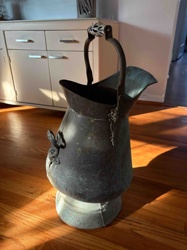
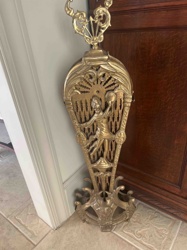
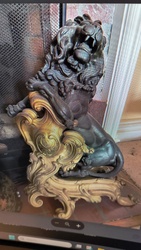
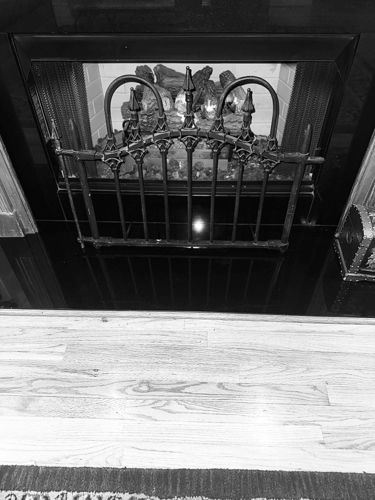
This is a decorative fireplace screen crafted in a Victorian Gothic Revival style. The piece is constructed from heavy-gauge wrought iron, finished in a dark, likely matte black or dark bronze tone. Structurally, it features a series of vertical pickets capped with decorative finials. The central section is distinguished by three distinct spiked finials, while the outer flanking sections curve into elegant rounded arches. An arched horizontal brace connects the pickets at the top, embellished with ornate, quatrefoil-inspired joinery typical of 19th-century metalwork architecture. The craftsmanship suggests a high level of detail, with visible texture in the iron and sturdy, welded or riveted connection points. In terms of condition, the screen appears to be well-maintained with a natural aged patina consistent with exposure to a fireplace environment. There is minor surface wear and what appears to be light oxidation or soot accumulation on the lower bars, but no signs of significant structural damage or modern repairs. The design indicates an estimated age from the late 19th to early 20th century, though it could also be a high-quality mid-century reproduction. The heavy base provides stability on the hearth, and its height is proportionate for a standard residential fireplace insert.
AI Appraisal Report

·AI can make mistakes·Verify before acting
I have virtually examined this Victorian Gothic Revival fireplace screen. Based on the heavy-gauge wrought iron construction and the specific quatrefoil joinery, the piece displays characteristic hallmarks of late 19th-century metalwork. The vertical pickets and spiked finials are consistent with the 'Gothic Revival' resurgence (c. 1860–1890), showing a level of blacksmithing detail—such as the texture of the iron and the integrity of the joints—that distinguishes it from lighter, mass-produced modern replicas. The condition is excellent for its age. The visible patina and light oxidation on the lower bars suggest authentic use and age-appropriate soot accumulation rather than a forced chemical finish. In the current decorative arts market, Gothic ironwork maintains a steady demand among collectors of period architectural hardware. Comparables sold at specialized auctions for similar three-panel or arched wrought iron screens generally fall within the $400 to $700 range, depending on weight and provenance. However, a definitive valuation is limited by the digital nature of this inspection. From images alone, I cannot verify the specific method of joinery (hand-hammered rivets versus modern spot welds hidden by finish) or the metallurgical composition of the iron. To fully authenticate the piece as a 19th-century original rather than a high-quality mid-20th-century reproduction, an in-person examination is required to check for 'maker’s marks,' signs of hand-tooling on the finials, and a physical weight test. Documentation of its history or residence of origin would also significantly bolster the premium value. For insurance purposes, I recommend a Replacement Value at the higher end of the provided range.

Get your items appraised

Instant estimates of your treasures with AI-powered appraisals

Browse More Appraisals