These notes were written by the person who submitted this item. Appraiser.AI has not verified them, and the AI's identification and estimate may rely on them.
AI Estimated Value
Not an official valuation
$15 - $35
AI estimate as of November 16, 2025 · verify with a professional before acting
AI-Generated · Verify before acting
Everything on this page is generated by AI for informational purposes only. AI can make mistakes — the AI may misidentify items or misattribute them (artist, maker, brand, designer, origin, era). This is not an official valuation and should not be used for insurance, sale, tax, estate, legal, or lending purposes — or any decision requiring a certified appraisal. It is not an authoritative claim about any person, brand, or rights holder — do not share or rely on it as a factual statement about a third party. Always consult qualified professionals before making financial decisions.
This analysis also relies on unverified notes provided by the user, which may be incomplete or inaccurate and could affect the result.
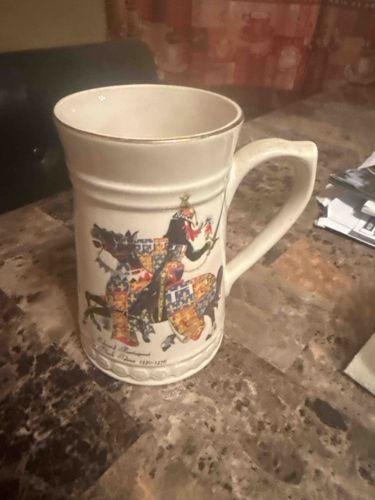
This item is a decorative ceramic mug, likely a tankard or stein, crafted from white earthenware or stoneware with a glazed finish. Its dimensions appear to be standard for a drinking mug, suggesting a height of approximately 4-6 inches and a diameter of 3-4 inches at the rim. The primary decorative feature is a colorful transfer print on one side, depicting a medieval knight on horseback in full armor, holding a spear or banner. The knight's armor and the horse's barding are intricately detailed with heraldic patterns in vibrant reds, blues, golds, and whites. Below the illustration, text is visible, which appears to read "Richard III" and possibly a date range like "1452-1485," indicating this is a commemorative piece related to the historical English monarch. The mug features a sturdy, C-shaped handle, also finished in white glaze. The rim of the mug is adorned with a thin gold-colored band, suggesting a touch of elegance or higher quality. Along the base and possibly just below the rim, there are horizontal raised bands or rings molded into the ceramic, providing textural interest and a traditional tankard aesthetic. The condition appears to be good, with no obvious chips, cracks, or significant wear visible on the exterior glaze or the decorative transfer. The gold rim shows no apparent signs of significant abrasion or loss. Given the context (made in England, reference to Richard III), it is likely a souvenir or commemorative piece, possibly dating from the latter half of the 20th century, particularly if it relates to a historical anniversary or resurgence of interest in the monarch. The craftsmanship appears to be commercially produced, with a focus on clear imagery and durable construction for everyday use or display.
AI Appraisal Report
I have carefully examined the provided image and details of this Richard III Commemorative Ceramic Mug. Visually, the mug appears to be in very good condition, with no visible chips, cracks, or significant wear to the glaze or the transfer print. The gold-colored rim shows no obvious abrasion. The 'Made in England' mark, combined with the subject matter, strongly suggests its origin as a souvenir or commemorative item, likely produced in the latter half of the 20th century, possibly around a historical anniversary.
This item falls into the category of mass-produced commemorative ceramic drinkware. While the depiction of Richard III is historically significant, such mugs are generally not rare. Market demand for these types of items is typically low unless associated with a particularly significant event or a manufacturer known for high-quality collectible ceramics. Comparable items, such as other historical or royal commemorative mugs from the same period, usually fetch modest prices in the secondary market. Factors impacting value include its good condition and historical subject. However, the commercial production nature and widespread availability of similar items limit its potential for high valuation.
It is important to note that my assessment of authenticity and condition is based solely on visual examination of the image. A full in-person examination would be required to definitively confirm the absence of hairline cracks, crazing, or subtle repairs, as well as to thoroughly inspect the base for maker's marks or date indications. Provenance documentation, though unlikely for such an item, would offer additional verification of its history.