These notes were written by the person who submitted this item. Appraiser.AI has not verified them, and the AI's identification and estimate may rely on them.
AI Estimated Value
Not an official valuation
$75-150
AI estimate as of August 13, 2025 · verify with a professional before acting
AI-Generated · Verify before acting
Everything on this page is generated by AI for informational purposes only. AI can make mistakes — the AI may misidentify items or misattribute them (artist, maker, brand, designer, origin, era). This is not an official valuation and should not be used for insurance, sale, tax, estate, legal, or lending purposes — or any decision requiring a certified appraisal. It is not an authoritative claim about any person, brand, or rights holder — do not share or rely on it as a factual statement about a third party. Always consult qualified professionals before making financial decisions.
This analysis also relies on unverified notes provided by the user, which may be incomplete or inaccurate and could affect the result.
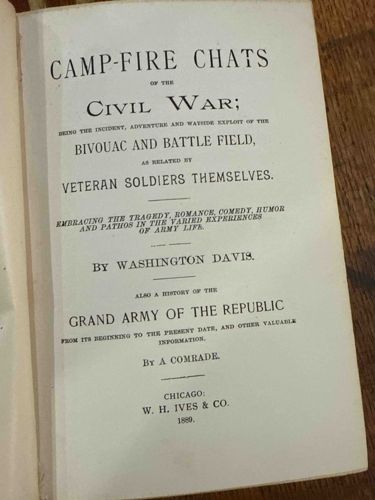
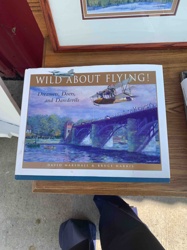
This item is the title page of a historical book titled "Camp-Fire Chats of the Civil War." The page is made of aged paper, likely a cream or off-white color, which has developed a subtle yellowish patina consistent with its age. The text is printed in black ink, featuring various font sizes and styles to differentiate sections, typical of late 19th-century typography. The title "CAMP-FIRE CHATS" is prominently displayed in large, sans-serif capital letters, followed by "of the Civil War;" in a more decorative, serif font. Beneath this, the subtitle reads, "BEING THE INCIDENT, ADVENTURE AND WATERSIDE EXPLOIT OF THE BIVOUAC AND BATTLE FIELD, AS RELATED BY VETERAN SOLDIERS THEMSELVES." The page also indicates that the book embraces "THE TRAGEDY, ROMANCE, COMEDY, HUMOR AND PATHOS IN THE VARIED EXPERIENCES OF ARMY LIFE," and is authored by "WASHINGTON DAVIS." Additionally, it includes "A HISTORY OF THE GRAND ARMY OF THE REPUBLIC" by "A COMRADE." The publisher is listed as "W. H. IVES & CO." of "CHICAGO," and the copyright or publication year is "1889." The visible portion of the book shows a single page of text, with the binding edge visible on the left, suggesting it is an intact part of a larger volume. There are no obvious tears, creases, or major stains visible on this specific page, indicating a relatively well-preserved condition for its age. The craftsmanship appears standard for mass-produced books of the era, with clear printing and legible text. The paper shows minor discoloration around the edges and general signs of aging, but no severe physical damage is apparent.
AI Appraisal Report
I have examined the provided image of the title page for "Camp-Fire Chats of the Civil War" and the additional owner's note "Camp fire chats illustrated." Based on this visual examination, the item appears to be an authentic title page from the 1889 publication. The typography, paper aging, and overall presentation are consistent with books published in the late 19th century. The visible condition of this single page is relatively good for its age, showing typical discoloration and patina but no obvious tears, creases, or major stains.
Limitations on authenticity verification from images alone are significant. While the title page looks correct, I cannot verify the completeness of the book, the presence and condition of all illustrations, or the binding's integrity. The phrase "Camp fire chats illustrated" from the owner is key, as the presence and quality of these illustrations significantly impact value. Without physical inspection, I cannot confirm that the entire volume is present, matching the description, or that it is not a facsimile or a composite of different books.
Market conditions for Civil War narratives by veterans are generally stable, with demand varying based on the author's prominence, the book's rarity, and its overall condition. "Camp-Fire Chats" is not considered a rare book; multiple copies surface in the market regularly. Copies with original illustrations in good condition typically fetch higher prices. Factors impacting value include the complete volume's condition, the presence of all illustrations, and any unique binding or provenance details. An in-person examination would be crucial to assess the full volume's condition, verify all contents, and rule out any repairs or alterations. Provenance documentation (e.g., prior ownership records) would further solidify authenticity and potentially add value.
For full authentication and a more precise valuation, a physical inspection is necessary to confirm the complete book's authenticity, its binding integrity, the presence and condition of all pages and illustrations, and to check for any repairs or restorations not visible in the image.