These notes were written by the person who submitted this item. Appraiser.AI has not verified them, and the AI's identification and estimate may rely on them.
AI Estimated Value
Not an official valuation
$350-550
AI estimate as of December 12, 2025 · verify with a professional before acting
AI-Generated · Verify before acting
Everything on this page is generated by AI for informational purposes only. AI can make mistakes — the AI may misidentify items or misattribute them (artist, maker, brand, designer, origin, era). This is not an official valuation and should not be used for insurance, sale, tax, estate, legal, or lending purposes — or any decision requiring a certified appraisal. It is not an authoritative claim about any person, brand, or rights holder — do not share or rely on it as a factual statement about a third party. Always consult qualified professionals before making financial decisions.
This analysis also relies on unverified notes provided by the user, which may be incomplete or inaccurate and could affect the result.
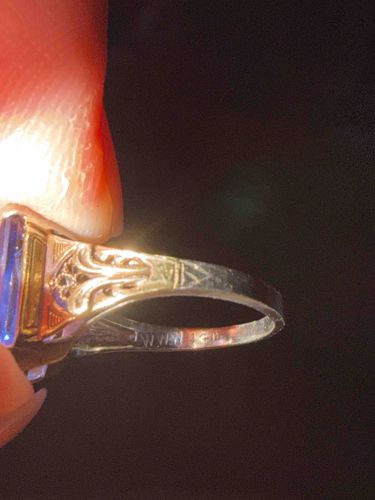
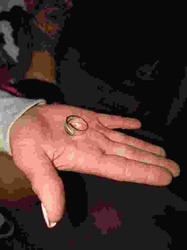
This item is an antique or vintage ring with a prominent faceted blue gemstone set in a white metal, likely gold given the '10K' marking visible on the inner band. The gemstone appears to be a rectangular or emerald cut, exhibiting a vibrant blue hue, possibly an aquamarine, blue topaz, or synthetic sapphire, though further testing would be required for definitive identification. The setting features elaborate filigree work characteristic of the Art Deco period (roughly 1920s-1930s). The shoulders of the ring display intricate openwork scroll and floral motifs, contributing to a delicate yet sturdy appearance. The band itself is relatively thin and bears some engraved or embossed geometric patterns on its outer surface, extending partially around the circumference. On the inside of the band, a clear '10K' hallmark is visible, indicating the gold purity. Adjacent to the 10K mark, there appears to be another stamped or engraved inscription, possibly a maker's mark or another partial hallmark, though it is not fully legible from the provided image. The ring shows moderate signs of wear consistent with its age, including some surface scratches and a natural patina on the metal. There are no immediately apparent signs of major damage or repairs, such as dents, cracks, or solder marks, but a thorough examination under magnification would be needed. The craftsmanship indicates a finely detailed piece, with attention paid to the decorative elements and secure setting of the stone. The overall quality suggests a well-made piece of jewelry from its era.
AI Appraisal Report
I have examined the provided image of this Art Deco Filigree Blue Stone Ring. Visually, the ring appears to be a genuine antique or vintage piece, consistent with the Art Deco period (1920s-1930s) based on its intricate filigree work, geometric patterns, and overall design aesthetic. The '10K' hallmark on the inner band strongly supports its authenticity as a gold item. The ring's condition is consistent with its age, showing moderate wear, surface scratches, and a natural patina, which are expected for a piece of this vintage. There are no immediate signs of significant damage from the image.
Market conditions for Art Deco jewelry remain stable, with a consistent demand for well-preserved examples. This ring's appeal lies in its classic Art Deco design elements and the prominent blue gemstone. While not exceedingly rare, quality Art Deco filigree rings are sought after. The main factor impacting the final value, beyond the gold content, is the identity and quality of the blue gemstone. Without in-person examination or testing, I cannot definitively identify the stone. It could be aquamarine, blue topaz, or a synthetic sapphire, each having a different impact on value. An aquamarine would typically command a higher value than blue topaz, while a synthetic sapphire would result in a lower valuation due to its manufactured origin.
To provide a more precise valuation and authenticate fully, a physical examination would be necessary to accurately identify the gemstone through refractivity or specific gravity tests, assess its quality (clarity, cut, color), and scrutinize the metal for any repairs or additional hallmarks not fully legible from the image. Further, provenance documentation, if available, could add significant value. My current appraisal range reflects the uncertainty regarding the gemstone's origin and assumes it is either a genuine aquamarine/blue topaz of moderate quality or a well-executed synthetic sapphire from the period.