AI Appraisal Estimate

AI-generated estimates · not official valuations

From the user

What was submitted

Photo and notes provided by the user — not generated by AI

Submitted item photo
Submitted photo · May 25, 2026

User's notes

1900-2000

AI analysis below

AI appraisal

AI analysis & estimate

AI-Generated · Verify before acting

Everything below is generated by AI for informational purposes only. AI can make mistakes — the AI may misidentify items or misattribute them (artist, maker, brand, designer, origin, era). This is not an official valuation and should not be used for insurance, sale, tax, estate, legal, or lending purposes — or any decision requiring a certified appraisal. It is not an authoritative claim about any person, brand, or rights holder — do not share or rely on it as a factual statement about a third party. Always consult qualified professionals before making financial decisions.

Note

This analysis also relies on unverified notes provided by the user, which may be incomplete or inaccurate and could affect the result.

Read the full disclaimer

AI Identification

·Not independently authenticated·Verify before acting

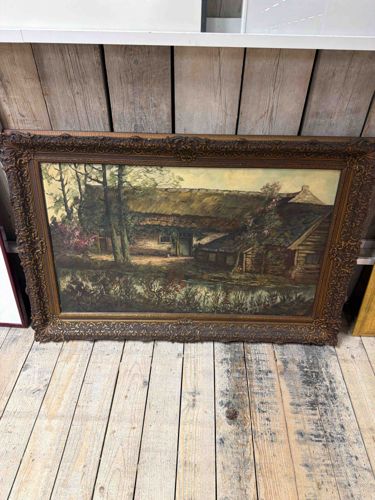
Dutch School Pastoral Landscape with Thatched Cottage

Fine Art - Oil Painting

AI Estimated Value

·Not an official valuation·Verify before acting

$1,200 - $1,800 USD

As of May 25, 2026

AI Item Analysis

·AI can make mistakes·Verify before acting
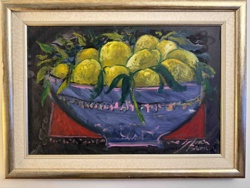
This large-scale oil painting on canvas depicts a rustic pastoral scene, likely inspired by the Dutch or Barbizon school traditions. The composition features a long, low-slung thatched-roof cottage or barn nestled among mature trees, possibly elms or oaks. In the foreground, a pond or slow-moving canal reflects the foliage of the bank, with small blossoms—perhaps rhododendrons—adding a splash of muted pink and purple to the left side of the midground. The color palette is dominated by earthy ochres, deep forest greens, and sepia tones, suggesting an afternoon light filtered through clouds. The work is housed in an exceptionally ornate, swept-style gilded wood and gesso frame. The frame features heavy scrollwork, acanthus leaf corner motifs, and a continuous floral pattern on the sight edge, characteristic of late 19th-century or early 20th-century revival styles. The painting shows signs of age-appropriate darkening of the varnish, which has added a yellowish-brown patina across the sky. There is evidence of slight craquelure consistent with oil works from the 1900-1950 period. The frame displays minor gesso loss and cracks in the corners, typical of decorative plasterwork from this era. No immediate artist signature is visible in the lower corners in this lighting, though the brushwork displays a confident, impressionistic quality with thick impasto in the highlights of the thatched roof and flowering bushes.
AI Appraisal Report

·AI can make mistakes·Verify before acting
I have carefully examined the provided digital imagery of this Dutch School pastoral landscape. My assessment reveals an oil painting executed with a confident, late-impressionist hand, likely dating between 1900 and 1930. The composition utilizes a sophisticated tonal palette of ochres and forest greens, while the application of impasto on the thatched roof and flora suggests a trained artist familiar with European plein-air traditions. The ornate swept-style gilded frame appears to be a period-appropriate late 19th-century revival piece, which adds significant decorative value, despite minor gesso losses. The visible craquelure and darkened varnish are consistent with the natural aging of linseed oil and resins from this period. Market demand for high-quality pastoral landscapes remains steady among traditional collectors, though values are currently dictated more by the decorative appeal and frame quality than by a specific unattributed artist. Comparables for unattributed Dutch School works of this scale typically realize between $1,000 and $2,000 at specialized auctions. Limitations: This evaluation is based on visual data only. A physical inspection is required to check for signatures under the frame lip or UV light (blacklight) to detect hidden repairs or overpainting. I cannot definitively verify the canvas substrate or specific pigments without scientific testing. To fully authenticate the work and potentially increase its value, I recommend a professional cleaning to remove the yellowed varnish and a thorough search for provenance documentation or an artist’s monogram hidden by the frame.

Get your items appraised

Instant estimates of your treasures with AI-powered appraisals

Browse More Appraisals