AI Appraisal Estimate

AI-generated estimates · not official valuations

From the user

What was submitted

Photo and notes provided by the user — not generated by AI

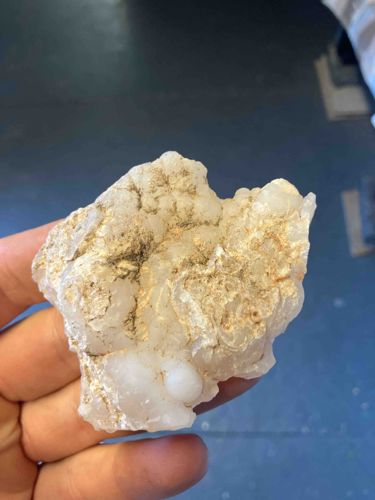
Submitted item photo
Submitted photo · May 28, 2026

User's notes

No additional notes provided.

AI analysis below

AI appraisal

AI analysis & estimate

AI-Generated · Verify before acting

Everything below is generated by AI for informational purposes only. AI can make mistakes — the AI may misidentify items or misattribute them (artist, maker, brand, designer, origin, era). This is not an official valuation and should not be used for insurance, sale, tax, estate, legal, or lending purposes — or any decision requiring a certified appraisal. It is not an authoritative claim about any person, brand, or rights holder — do not share or rely on it as a factual statement about a third party. Always consult qualified professionals before making financial decisions.

Read the full disclaimer

AI Identification

·Not independently authenticated·Verify before acting

Milky Quartz or Chalcedony Specimen

Mineral Specimen

AI Estimated Value

·Not an official valuation·Verify before acting

$20-40

As of May 28, 2026

AI Item Analysis

·AI can make mistakes·Verify before acting
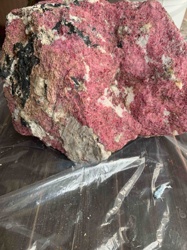
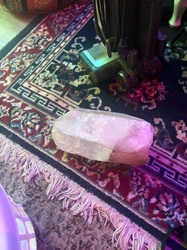
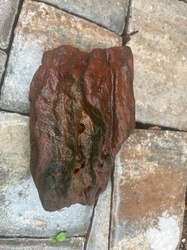
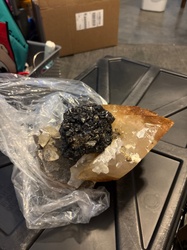
The item is a raw, unpolished specimen of what appears to be milky quartz or a similar cryptocrystalline silica mineral, possibly with some chalcedony or agate formations. It is irregular in shape, characteristic of a naturally occurring geological fragment. The dominant color is an opaque to translucent white, with areas exhibiting a slightly off-white or light cream hue, indicating the presence of other impurities or mineralogical variations. Visible in the matrix are areas of granular texture and some more rounded, botryoidal-like growths, suggesting formation within a vug or as a concretion. There are also deposits of a light brown or sandy-colored material, likely dirt, clay, or other mineral staining, embedded within the crevices and on the rough surfaces. The overall surface is uneven, showcasing the natural fracture patterns and crystalline structures. The size is small enough to be held comfortably in one hand, as depicted, implying dimensions likely in the range of 5-10 cm at its widest points. No specific maker's marks or signatures are present, as is common for natural mineral specimens. The item's condition appears natural and unaltered, with no obvious signs of recent damage, repairs, or polishing. Its visual characteristics suggest a natural formation process over a geological timescale, making an 'estimated age' in human terms irrelevant; rather, its age is geological. The piece exhibits the raw beauty of natural mineral formation, with its quality indicated by the clarity of the quartz where visible, and the interesting textural variations.

AI Appraisal Report

·AI can make mistakes·Verify before acting
Upon visual examination of the provided image, this specimen appears to be a natural formation, consistent with milky quartz or perhaps a chalcedony/agate combination. Its raw, unpolished state and irregular shape are typical of an unaltered geological fragment. The overall condition appears excellent for a natural specimen, with no evidence of recent damage, repairs, or artificial enhancement. The varied texture, including granular areas and botryoidal-like growths, adds aesthetic interest. The brownish deposits are likely natural staining or residual matrix material. Market comparables for such raw, unpolished silica specimens vary significantly based on size, crystal formation, and aesthetic appeal. While it exhibits interesting texture and some translucency, it is a common mineral type without exceptional rarity or fine crystal habit often sought by high-end collectors. Demand for common quartz specimens like this is generally modest. The primary value impactors are its natural aesthetic qualities and size. Due to the limitations of image-based appraisal, I must state that full authentication regarding specific mineral identity beyond general silica (quartz/chalcedony) and precise origin cannot be definitively determined. An in-person examination, including hardness testing, density measurement, and potentially microscopic analysis, would be necessary to confirm its exact mineralogy and rule out artificial materials or treatments. Provenance documentation, though rarely available for raw specimens, could provide additional context regarding its discovery site. Without such testing, the appraisal is based on visual characteristics alone.

Get your items appraised

Instant estimates of your treasures with AI-powered appraisals

Browse More Appraisals