These notes were written by the person who submitted this item. Appraiser.AI has not verified them, and the AI's identification and estimate may rely on them.
AI Estimated Value
Not an official valuation
$75 - $150
AI estimate as of July 17, 2025 · verify with a professional before acting
AI-Generated · Verify before acting
Everything on this page is generated by AI for informational purposes only. AI can make mistakes — the AI may misidentify items or misattribute them (artist, maker, brand, designer, origin, era). This is not an official valuation and should not be used for insurance, sale, tax, estate, legal, or lending purposes — or any decision requiring a certified appraisal. It is not an authoritative claim about any person, brand, or rights holder — do not share or rely on it as a factual statement about a third party. Always consult qualified professionals before making financial decisions.
This analysis also relies on unverified notes provided by the user, which may be incomplete or inaccurate and could affect the result.
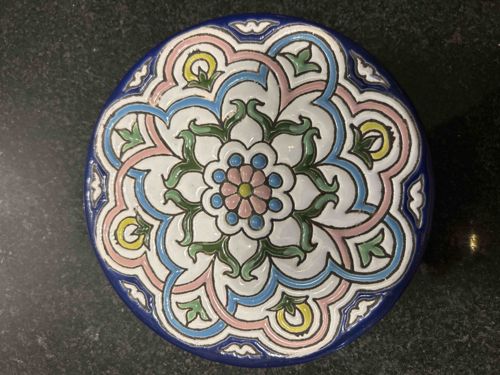
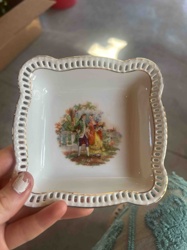
This is a circular ceramic decorative plate or shallow bowl, likely hand-painted and glazed, displaying a vibrant and intricate floral-geometric motif. The central design features a stylized six-petal flower in shades of light pink and yellow with light blue dots around its core. Surrounding this central medallion is a complex pattern of interlocking, curvilinear shapes reminiscent of Moorish or Mediterranean tilework. The color palette includes prominent use of light blue, soft pink, pale yellow, and dark green, all outlined in a distinctive dark blue or black raised line, which suggests a 'cuerda seca' or similar outlining technique where the lines prevent colors from bleeding during firing. The background within the motif is a clean white, providing excellent contrast. The perimeter of the piece features a solid dark blue band, which appears to be part of the rim. The overall construction appears robust, and the glaze exhibits a high sheen, indicating proper firing. There are no immediate visible signs of major damage like chips or cracks, and the color saturation remains strong, suggesting good preservation. The raised outlining gives the piece a tactile quality and defines the intricate details of the pattern. The craftsmanship appears to be of good quality, with precise application of colors within the outlined areas. This style is often associated with traditional ceramics from regions like Italy, Spain, or North Africa, possibly dating from the mid-20th century onwards, though without a maker's mark or more context, exact dating is difficult. Its dimensions appear to be suitable for a wall hanging or a tabletop display piece.
AI Appraisal Report
Based on my visual examination of the Hand-Painted Ceramic Decorative Plate, I can assess its condition and potential value. The plate appears to be in very good condition, showing no major chips, cracks, or significant loss of glaze. The colors remain vibrant and well-saturated, indicating good preservation. The raised outlining technique, likely 'cuerda seca,' is precisely applied, suggesting skilled craftsmanship. The detailing of the floral-geometric motif is intricate and visually appealing.
From the image alone, I can confirm the decorative quality and the apparent good state of preservation. However, it's crucial to note that I cannot definitively verify authenticity or origin from images alone. A physical in-person examination would be required to check for potter's marks, impressed factory names, specific clay body characteristics, and the precise feel of the glaze, all of which are vital for accurate dating and attribution. Provenance documentation, such as receipts or records of ownership, would also be invaluable. Scientific testing, like thermoluminescence dating for older pieces, could provide age confirmation.
In terms of market conditions, decorative ceramic plates with intricate hand-painted designs from regions like Italy, Spain, or North Africa generally have a modest ولكن steady demand. Comparable pieces, often labeled as 'Majolica style,' 'Faience,' or 'Mediterranean ceramic art,' can be found across various online marketplaces and antique shops. The demand is primarily from collectors of decorative arts, those looking for unique home decor, or individuals interested in specific regional ceramic traditions. Rarity is difficult to assess without maker's marks or definite attribution; many similar pieces were produced. Factors impacting value include the artist's reputation (if known), the fame of the specific workshop or factory, the actual age (true antique vs. vintage reproduction), and verifiable origin. Without these, it would be valued as a general decorative piece.
Considering the current market for decorative ceramics of this type, and assuming it is a well-made vintage piece (mid-to-late 20th century) rather than a high-value antique collectible, I would place its retail appraisal value in the range provided. The lack of identifiable marks or clear provenance restricts a higher valuation.