AI estimate as of November 11, 2025 · verify with a professional before acting
AI-Generated · Verify before acting
Everything on this page is generated by AI for informational purposes only. AI can make mistakes — the AI may misidentify items or misattribute them (artist, maker, brand, designer, origin, era). This is not an official valuation and should not be used for insurance, sale, tax, estate, legal, or lending purposes — or any decision requiring a certified appraisal. It is not an authoritative claim about any person, brand, or rights holder — do not share or rely on it as a factual statement about a third party. Always consult qualified professionals before making financial decisions.
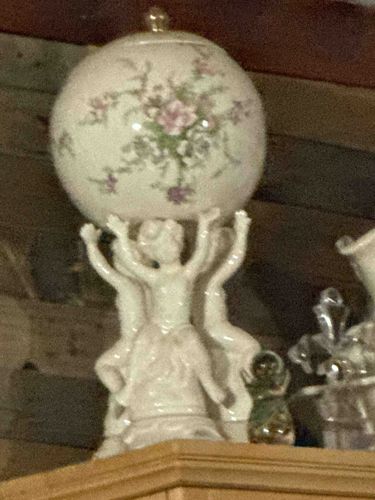
This item is a decorative covered urn or potpourri holder, characterized by a rounded, spherical top resting on a figural pedestal. The spherical top, likely ceramic or porcelain with a glossy glaze, is adorned with a floral motif featuring soft pink and purple blossoms with green foliage, typical of a romantic or traditional aesthetic often found on fine china. A small, brass-toned finial crowns the lid. The pedestal consists of three figures, appearing to be cherubs or classical nymphs, rendered in white ceramic or porcelain. Each figure is sculpted with arms raised, seemingly supporting the spherical element above them. They are depicted with draped clothing around their lower bodies. The overall form suggests a late Victorian or early 20th-century decorative style, emphasizing intricate detailing and a delicate color palette. The condition appears to be generally good, though the image quality makes it difficult to discern subtle flaws like crazing, chips, or repairs. No visible maker's marks or signatures are identifiable from the provided images, which would be crucial for a definitive appraisal. The craftsmanship seems to be of reasonable quality for decorative ceramic art of this nature, with the figures showing some detail in their drapery and pose. This piece would likely serve as an ornamental item for a mantelpiece, shelf, or display cabinet.
AI Appraisal Report
I have examined the image provided of this Figural Pedestal Covered Urn or Potpourri Holder. This piece presents as a decorative ceramic item, likely dating from the late Victorian to early 20th century, characterized by its floral-decorated spherical top and three-figure pedestal. The floral motif on the spherical top is typical of the era, and the white ceramic figures, possibly cherubs or nymphs, suggest classical influences often found in decorative arts of that period.
Based on visual assessment, the condition appears good; however, without a physical examination, I cannot definitively confirm the absence of subtle flaws such as crazing, chips, or repairs, which are common in items of this age and material. The image resolution also prevents a conclusive assessment of surface irregularities or firing imperfections. Authenticity cannot be confirmed from an image alone; I would need to inspect the item in person for maker's marks, production methods, and material quality.
In terms of market conditions, similar decorative ceramic urns or potpourri holders from this period, without definitive artist attribution or high-end provenance, generally command modest prices. Comparables in the secondary market suggest a value for such a decorative piece that relies heavily on aesthetic appeal rather than rarity or historical significance. There is a consistent but not robust demand for such items, typically driven by collectors of period decor rather than fine art. Factors significantly impacting value would include verifying manufacturer, confirming the material as high-quality porcelain versus ceramic, and ruling out any extensive restoration.
To fully authenticate this piece and provide a more precise valuation, a direct in-hand inspection would be necessary. This would allow me to examine for maker's marks, assess the true condition, analyze the material composition, and potentially identify any restoration. Documentation of provenance, if available, would also be critical.