AI Appraisal Estimate

AI-generated estimates · not official valuations

From the user

What was submitted

Photo and notes provided by the user — not generated by AI

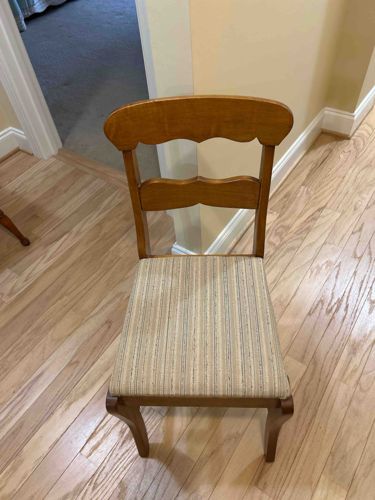
Submitted item photo
Submitted photo · June 6, 2026

User's notes

No additional notes provided.

AI analysis below

AI appraisal

AI analysis & estimate

AI-Generated · Verify before acting

Everything below is generated by AI for informational purposes only. AI can make mistakes — the AI may misidentify items or misattribute them (artist, maker, brand, designer, origin, era). This is not an official valuation and should not be used for insurance, sale, tax, estate, legal, or lending purposes — or any decision requiring a certified appraisal. It is not an authoritative claim about any person, brand, or rights holder — do not share or rely on it as a factual statement about a third party. Always consult qualified professionals before making financial decisions.

Read the full disclaimer

AI Identification

·Not independently authenticated·Verify before acting

Mid-Century Country Style Ladder Back Dining Chair

Furniture

AI Estimated Value

·Not an official valuation·Verify before acting

$75.00 - $125.00

As of June 6, 2026

AI Item Analysis

·AI can make mistakes·Verify before acting
This is a wooden side chair featuring a transitional design that blends mid-century utilitarianism with traditional country influences. The chair is constructed from light-to-medium toned wood, likely maple or beech, with a warm honey finish. It features a decorative ladder-back design with two horizontal slats; the top rail is wide and shaped with a subtle scalloped bottom edge, mirrored by a secondary central slat with a similar double-curved silhouette. The vertical stiles are straight, tapering slightly upwards. The seat is square-fronted and upholstered in a multi-colored vertical striped fabric featuring muted shades of tan, beige, and faint blue/gray, suggesting a late 20th-century aesthetic. The front legs are slightly cabriole-shaped, providing a more elegant curve compared to the standard straight legs found on utility chairs, and they are joined to the seat frame with visible wood blocks. In terms of condition, the piece appears well-maintained with minor surface abrasions and light wear consistent with age and domestic use, particularly around the foot of the legs. The joinery appears tight, and the upholstery shows no significant staining or fraying. No maker's mark is visible from this angle, but the mass-produced style suggests a mid-to-late 20th-century manufacture date, possibly a reproduction piece mimicking Early American styles.
AI Appraisal Report

·AI can make mistakes·Verify before acting
I have examined the digital representation of this wooden ladder back dining chair. The piece exhibits characteristics of a mass-produced mid-to-late 20th-century reproduction of Early American/Country styles. The wood appears to be a common hardwood like maple or beech with a standard honey finish. While the scalloped slats and slight cabriole front legs add a decorative flair, the construction methods—specifically the visible wood blocking in the seat frame—suggest a utilitarian, commercial manufacture rather than artisan craftsmanship. The condition is good, with only minor abrasions consistent with age; the upholstery is intact but dated, likely from the 1980s or 90s. The market for single, mass-produced chairs of this style is currently soft, as most buyers seek complete sets of four or six chairs. It is treated primarily as a functional decorative piece rather than a collector's item. Valuations are based on similar recent sales of unbranded revival furniture in secondary markets. My assessment is limited by the digital nature of this inspection; I cannot verify wood density, the presence of hidden maker's stamps under the seat frame, or the structural integrity of the joinery under pressure. A full authentication would require an in-person physical examination to determine internal joinery methods (dowel vs. mortise and tenon), a tactile inspection of the finish to check for modern lacquers versus traditional varnishes, and documentation or labeling providing a specific manufacturer or provenance.

Get your items appraised

Instant estimates of your treasures with AI-powered appraisals

Browse More Appraisals