These notes were written by the person who submitted this item. Appraiser.AI has not verified them, and the AI's identification and estimate may rely on them.
AI Estimated Value
Not an official valuation
$100-$130
AI estimate as of September 25, 2025 · verify with a professional before acting
AI-Generated · Verify before acting
Everything on this page is generated by AI for informational purposes only. AI can make mistakes — the AI may misidentify items or misattribute them (artist, maker, brand, designer, origin, era). This is not an official valuation and should not be used for insurance, sale, tax, estate, legal, or lending purposes — or any decision requiring a certified appraisal. It is not an authoritative claim about any person, brand, or rights holder — do not share or rely on it as a factual statement about a third party. Always consult qualified professionals before making financial decisions.
This analysis also relies on unverified notes provided by the user, which may be incomplete or inaccurate and could affect the result.
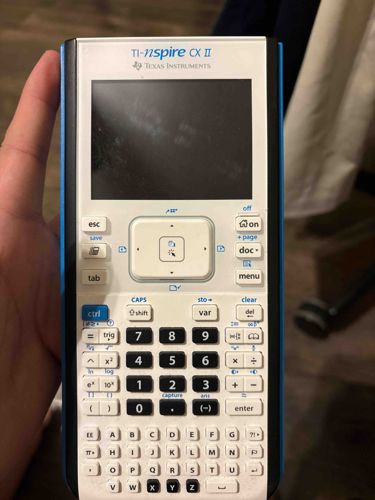
This item is a Texas Instruments TI-Nspire CX II graphing calculator, readily identifiable by the 'TI-nspire CX II' and 'TEXAS INSTRUMENTS' branding prominently displayed above the screen. The calculator features a sleek design with a primary color scheme of white for the body and a vibrant blue for the side casing, with black accents for the keys and screen bezel. It has a large, full-color LCD screen, which shows some visible smudges and possibly a light film or dust, suggesting moderate use. Below the screen is a comprehensive keyboard layout, divided into several functional zones. There's a navigational touchpad-like area in white, surrounded by various function keys such as 'esc', 'save', 'tab', 'on', 'off', '+page', 'doc', and 'menu'. Further down, a standard numerical keypad with keys '0' through '9' is arranged in a typical calculator format, with additional arithmetic operators ('+', '-', '*', '/', 'enter') and mathematical functions ('= trig', 'ctrl', 'log', '10^x') on the sides. A full QWERTY keyboard is present at the very bottom, indicating advanced functionality for text input and programming. The keys are a mix of white (for the navigational keys) and black (for numeric and QWERTY keys), with white lettering. The overall condition appears used but functional, with no apparent major cracks or damage, although the screen could use cleaning. The light-colored casing might show minor scuffs or discoloration upon closer inspection, but none are clearly visible in the provided images. This model is commonly used in educational settings for algebra, calculus, and other advanced mathematics courses, reflecting its modern manufacturing and robust design.
AI Appraisal Report
Upon examining the provided image and details, I can confidently identify this as a genuine Texas Instruments TI-Nspire CX II graphing calculator. The branding, color scheme (white body, blue side casing), screen, and comprehensive keyboard layout, including the navigational touchpad, numeric keypad, and full QWERTY keyboard, are all consistent with this model.
The calculator appears to be in used but functional condition. The visible smudges and light film on the screen suggest moderate use, and while no major damage is apparent, a physical inspection would be needed to confirm the absence of deep scratches on the screen or body. The light-colored casing could also harbor minor scuffs or discoloration not visible in the image.
Market conditions for used TI-Nspire CX II calculators are generally robust due to their widespread use in educational settings. Given its modern manufacturing and robust design, demand is consistently strong. Comparable used models in good working order typically sell in the range of $100-$130, sometimes higher depending on accessories like charging cables or cases. This is not a rare item, so rarity does not significantly impact its value.
Factors impacting value here include its used condition, which places it below new retail prices (typically around $150-$170). The slight screen contamination, while minor, also suggests it's not in pristine condition.
It is important to note that my authenticity verification is limited to visual examination from the image. For full authentication and a definitive assessment of internal components and battery health, an in-person examination, potentially accompanied by testing its functionality, would be required. Provenance documentation would be useful to verify ownership history, though it's less critical for an item of this nature.